India's management education landscape is quietly going through its most significant shift in decades. Hiring managers across IT, BFSI, e-commerce, logistics, and analytics are no longer asking whether a candidate holds an MBA; they are asking when the candidate earned it, what they learned, and how they applied it. At the same time, remote-first workplaces, digital credentialing, and the mainstreaming of UGC-entitled online degrees have removed the old compulsion to quit a job or relocate to a metro city for quality management education.
This changes the most common question among students and their families. It is no longer “Should I do an MBA?” It is now: “Should I do it right after graduation, or should I work first?”
The honest answer is that neither path is universally better. Each suits a different kind of learner, and the right choice depends on career clarity, financial position, and how a person intends to use the degree. This article breaks that decision down objectively without bias, and with a practical framework anyone can apply.
Table of Contents
- The Trends Reshaping When People Pursue Management Education
- Path One: The MBA Straight After Graduation
- Path Two: The MBA After Work Experience
- Side-by-Side: After Graduation vs After Work Experience
- The RIPE Test: A Framework for Timing Your MBA
- But First Is the Format Itself Credible?
- Clearing the Confusion: Three Formats, Three Very Different Things
- Choosing a Specialisation: Where Career Timing Meets Career Direction
- What Should a Learner Actually Verify Before Enrolling?
- The Final Verdict
- Frequently Asked Questions
The Trends Reshaping When People Pursue Management Education
Before comparing the two paths, it helps to understand why this question has become so common. Several workforce trends have converged:
- Employers now reward demonstrated skill over pedigree. Promotions increasingly go to professionals who can show applied management capability, not just a certificate year.
- The average age of MBA learners is rising. A growing share of management students in India are working professionals in their late 20s and 30s, studying alongside full-time jobs.
- Online degrees have achieved legal parity. Degrees delivered online by UGC-entitled universities carry the same validity as on-campus degrees for jobs, promotions, and higher studies.
- Specialisation demand has exploded. Roles in supply chain, analytics, and digital marketing now expect domain-specific management knowledge, not just general administration.
- Career switching has normalised. Professionals routinely move industries mid-career, and a management qualification is the most common bridge for that switch.
These trends mean the “right time” for an MBA is no longer dictated by convention. It is dictated by individual readiness.
Path One: The MBA Straight After Graduation
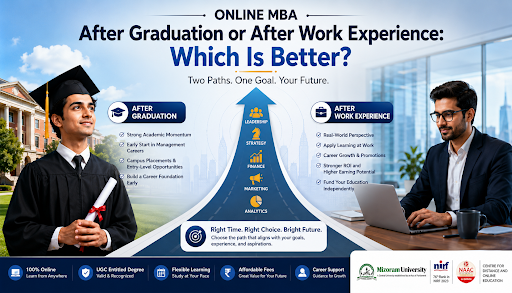
For a fresh graduate, pursuing management education immediately keeps academic momentum alive. Concepts from a BBA, B.Com, or even a B.Tech flow naturally into postgraduate coursework, and the learner enters the job market with a master's qualification already in hand.
Where this path works well:
- The student has clear career direction and does not need workplace exposure to discover it.
- The family or student can support the fee without loan pressure, which is where affordable public university programmes matter enormously.
- The target roles (management trainee, analyst, associate) list a postgraduate degree as an entry filter.
- The student wants to sit for placements, campus-linked opportunities, or competitive examinations where a master's degree adds eligibility or weight.
Where this path struggles:
- Classroom case studies feel abstract without lived workplace context.
- Salary negotiation power is limited because the degree is not yet backed by experience.
- Career direction chosen at 21 sometimes changes by 25, making an early specialisation feel misaligned later.
Typical roles a fresh postgraduate targets: Management Trainee, Business Analyst, HR Executive, Marketing Associate, Operations Executive, Financial Analyst, Sales Team Lead, Junior Consultant.
Path Two: The MBA After Work Experience
The professional who works for two to five years and then studies management brings something a classroom cannot teach: Context. Every lecture on organisational behaviour, budgeting, or negotiation maps to something they have actually seen. This is why experienced learners consistently report deeper engagement with coursework.
This is also where the online format becomes decisive. A working professional cannot pause a career for two years, and no longer needs to. A flexible, fully digital programme such as the Mizoram University Online MBA allows professionals to study from any city while continuing to earn, apply lessons at work in real time, and graduate without an employment gap on their CV.
Where this path works well:
- The learner knows exactly which function they want to grow in finance, HR, marketing, supply chain, or analytics.
- The degree is being used strategically: for a promotion, a domain switch, or a move from execution roles into management.
- The professional can fund the programme from their own income, avoiding education debt entirely.
- Real projects at work double as live case studies, making learning immediately applicable.
Where this path struggles:
- Balancing job, family, and study demands genuine discipline.
- Waiting too long (8–10+ years) can shrink the return window before senior roles are reached.
Typical roles experienced learners move into: Assistant Manager, HR Business Partner, Finance Manager, Marketing Manager, Supply Chain Manager, Data Analytics Lead, Product Manager, Operations Manager, Entrepreneur / Founder.
Side-by-Side: After Graduation vs After Work Experience
| Decision Factor | After Graduation | After Work Experience |
|---|---|---|
| Learning depth | Theoretical; concepts absorbed academically | Applied; concepts mapped to real workplace situations |
| Financial model | Family-funded or loan-dependent | Usually self-funded from salary |
| Career clarity | Often still forming | Usually well-defined |
| Immediate outcome | Entry into job market with a PG degree | Promotion, hike, or domain switch |
| Salary leverage | Moderate degree without experience | High degree stacked on proven experience |
| Risk | Choosing a specialisation before knowing the industry | Study-work-life balancing pressure |
| Best suited for | Focused fresh graduates with clear goals | Professionals seeking managerial transition |
The table makes one thing clear: this is not a question of better; it is a question of fit.
The RIPE Test: A Framework for Timing Your MBA
To make this decision objectively, apply the RIPE Test, a four-point readiness check built on patterns commonly observed among management aspirants across India:
- R – Role Clarity: Can you name the exact role you want three years from now? If yes, you are ready whether you are a fresher or a professional. If no, work first; the workplace will answer this faster than a classroom.
- I – Income Stability: Can you fund the programme without financial strain? If a degree requires heavy borrowing, working first and choosing an affordable UGC-entitled public university programme is the financially mature route.
- P – Purpose of the Degree: Is the MBA meant to enter the job market or to accelerate within it? Entry favours studying early; acceleration favours studying after experience.
- E – Experience Leverage: Will your current or past work experience multiply the value of what you study? If you already have 2+ years of experience, an MBA now compounds it. If you have none, the degree stands alone.
Scoring: If three or more answers point the same way, that is your path. A split verdict usually means: work for 1–2 years, then enrol in an online or hybrid route that has become the most popular choice in India today.
Ready to evaluate the programme itself? Visit the Official MBA Admission Page to review eligibility, curriculum, and admission timelines.
Ready to take the next step in your career? Explore our UGC-DEB approved Online MBA programme.
Explore Online MBABut First Is the Format Itself Credible?
The timing question only matters if the degree earns respect. So let's address the concern directly, because “is online MBA respected” remains one of the most searched doubts among Indian students and parents, and the answer has changed dramatically in recent years. Degrees delivered online by UGC-entitled universities are legally equivalent to their on-campus counterparts. Recruiters today evaluate three things: the awarding university's status (Central, State, or private), its accreditation grade, and the learner's demonstrable skills. When the awarding institution is a Central University created by an Act of Parliament and accredited by NAAC, the format of delivery stops being a question mark.
What strengthens this credibility further is the credential itself. The Mizoram University Online MBA Certificate is a full postgraduate degree, not a diploma or a short-course credential awarded by a Central University, making it valid for private-sector employment, public-sector recruitment, promotions, and further education such as a PhD or international master's programmes. For parents evaluating recognition and for professionals planning government examinations, this distinction between a degree and a certificate course is one of the most important checks to perform before enrolling anywhere.
Clearing the Confusion: Three Formats, Three Very Different Things
Students frequently mix up regular, online, and distance formats, and the confusion is worth untangling, because the difference between MBA and Online MBA is about delivery, not value; the syllabus, degree, and recognition remain comparable when the university is UGC-entitled:
| Parameter | Regular (On-Campus) MBA | Online MBA |
|---|---|---|
| Mode | Physical classrooms, fixed schedule | Live + recorded classes, flexible schedule |
| Location | Relocation often required | Study from anywhere |
| Career continuity | Usually requires a career break | Continue working while studying |
| Cost structure | Higher (tuition + hostel + relocation) | Significantly lower overall |
| Networking | In-person peer network | Digital peer and alumni network |
| Degree validity | Fully valid | Fully valid when UGC-entitled |
| Best for | Full-time students seeking campus life | Professionals and remote learners |
Equally important is the difference between online MBA and distance learning MBA, because these two are wrongly used as synonyms and choosing the wrong one affects the entire learning experience:
| Parameter | Online MBA | Distance Learning MBA |
|---|---|---|
| Teaching mode | Live interactive classes + LMS + recorded lectures | Primarily self-study material sent physically or digitally |
| Faculty interaction | Regular and real-time | Minimal; mostly during contact sessions |
| Examinations | Often online, proctored | Usually at physical exam centres |
| Learning experience | Structured, engaging, technology-driven | Independent, correspondence-style |
| Peer engagement | Discussion forums, group projects | Largely absent |
| Ideal learner | Working professionals wanting classroom rigour with flexibility | Learners needing only a qualification with minimal engagement |
The short version: online learning replicates the classroom digitally; distance learning replaces the classroom with self-study. For most career-focused learners, the former delivers substantially more value.
Choosing a Specialisation: Where Career Timing Meets Career Direction
Whichever timing path a learner chooses, the specialisation decision determines the career lane. A useful guiding principle: freshers should pick the specialisation aligned to the industry they want to enter; professionals should pick the one aligned to the role they want to grow into.
Here is how the major specialisations map to careers:
- Human Resource Management for those drawn to people, culture, and
organisational growth. Roles: HR Generalist, Talent Acquisition
Manager, HR Business Partner, L&D Manager.
Explore MBA HR - Finance for analytical minds targeting BFSI, corporate finance, or
investment roles. Roles: Financial Analyst, Credit Manager, Risk
Analyst, Finance Manager.
Explore MBA Finance - Marketing for creative-strategic thinkers in the digital economy.
Roles: Brand Manager, Digital Marketing Manager, Growth Manager,
Sales Head.
Explore MBA Marketing - Logistics & Supply Chain Management one of India's fastest-growing
functions, powered by e-commerce and manufacturing expansion. Roles:
Supply Chain Analyst, Procurement Manager, Logistics Manager,
Warehouse Operations Head.
Explore MBA Logistics & Supply Chain - Big Data Analytics for those who want management roles at the
intersection of business and data. Roles: Business Analyst, Data
Analytics Manager, BI Consultant, Analytics Lead.
Explore MBA Big Data Analytics - Entrepreneurship for founders, family-business successors, and
intrapreneurs. Roles: Startup Founder, Business Development Head,
Venture Analyst, Franchise Owner.
Explore MBA Entrepreneurship
What Should a Learner Actually Verify Before Enrolling?
Reviews matter, but they must be read intelligently. When evaluating any Mizoram University Online MBA review, or reviews of any online programme, the smarter approach is to check four verifiable anchors rather than anonymous opinions: the university's UGC-DEB entitlement status (verifiable on the UGC-DEB portal), its NAAC accreditation grade, its status as a Central University established by an Act of Parliament, and the transparency of its fee structure. Reviews describe experience; these four anchors describe legitimacy. A programme that scores on all four gives learners a foundation that no unverified online opinion can shake.
A related question deserves a direct answer, because it is asked far more often than most people assume: can you do an MBA without a degree? No, under Indian higher-education regulations, an MBA is a postgraduate qualification, and a completed bachelor's degree in any discipline from a recognised university is mandatory. Learners without graduation should first complete an undergraduate programme (a BBA or B.Com is a natural feeder), or explore certificate and skill-based management courses in the interim. Any institution offering an “MBA without graduation” should be treated as a serious red flag.
The Final Verdict
Pursue management education after graduation if career clarity is high, funding is comfortable, and the goal is to enter the job market with a postgraduate edge. Pursue it after work experience if the goal is acceleration a promotion, a domain switch, or a leadership transition because experience multiplies everything the classroom teaches.
And if the verdict is split? Work briefly, then study online while earning. It is the path that carries the least risk, the least debt, and increasingly, the strongest career returns. For learners taking that route, an affordable Central University programme with NAAC accreditation and UGC-DEB entitlement such as the Mizoram University MBA Online offers the rare combination of government-backed credibility and complete scheduling freedom, which is precisely what a working learner needs.
Planning your budget? Read the complete fee structure here: Online MBA Fees & Admission Details
Frequently Asked Questions
For learners seeking a recognised postgraduate management degree without a career break, yes. The programme combines Central University credibility, NAAC accreditation, industry-relevant specialisations, and an affordable fee structure a combination that delivers strong return on investment for both fresh graduates and working professionals.
Yes. The university is a Central University established by an Act of Parliament and is UGC-DEB-entitled to offer online degree programmes. The degree awarded is fully valid for employment, higher education, and competitive examinations.
Yes, the programme is specifically structured for them. Live and recorded classes, a flexible LMS, and online assessments allow professionals to study without resigning, relocating, or pausing their careers.
Yes, provided it is earned from a UGC-entitled, accredited university. Employers today assess the awarding institution's credibility and the candidate's skills, not the mode of delivery. A degree from an accredited Central University carries the same weight as its on-campus equivalent.
Yes. Degrees from UGC-entitled universities delivered online are valid for government recruitment, public-sector examinations, and departmental promotions, subject to the specific eligibility criteria of each examination or post.
Take the next step: Compare specialisations, check eligibility, and begin your application on the Official MBA Admission Page.
Need Help Deciding on Your Next Career Step? We're Here to Guide You!

Chat with Us
If you're feeling unsure, our friendly and experienced counseling team is available to answer all your questions. No bots here—just real people dedicated to helping you make the right decision.

WhatsApp Assistance
Need quick advice on the go? Our experts are available 24x7 on WhatsApp to chat with you. Drop us a message anytime, and we'll provide the information you need, all at your convenience.
WhatsApp Assistance
Give Us a Ring
Sometimes, a direct conversation is what you need to gain clarity. If you still have questions after chatting or messaging, give us a call. Our experts are here to provide 24x7 guidance tailored to your career path
Call Now