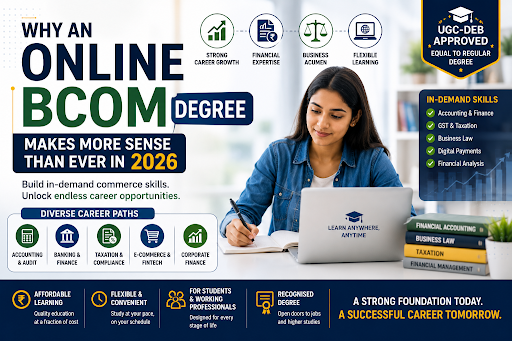
Something has shifted in how the business world thinks about commerce education. For a long time, commerce graduates occupied a predictable middle tier: respected, employable, but rarely at the centre of the conversations that shaped industries. That positioning has changed. The expansion of fintech, the formalisation of India's small business economy, the growth of e-commerce and digital payments, and the increasing complexity of tax compliance in the post-GST era have all created sustained demand for professionals with a strong foundation in accounting, finance, and business law.
At the same time, the way people access higher education has fundamentally changed. The UGC's formal recognition of online degrees from accredited institutions as equivalent to campus degrees for employment and further study has removed the last significant regulatory barrier to choosing an online degree deliberately. A student in Ranchi, a working professional in Surat, and a homemaker in Madurai who wants to resume a paused education each of them now has genuine access to a rigorous, recognised commerce degree without relocating, pausing their income, or restructuring their life.
These two shifts, the rising relevance of commerce skills and the expanding accessibility of online degrees, are converging in 2026 in a way that makes the Online Bachelor Degree in Commerce one of the most practically relevant educational investments available. This blog is about why that is true, what the programme covers, and how to determine whether it is the right choice for your specific situation.
Table of Contents
- What the Economy Is Asking For
- Who Is Choosing an Online Commerce Degree And Why
- Who Can Apply and How to Get Started
- What the Degree Covers: A Curriculum Built for the Working Economy
- Recognition and Validity: What You Need to Know
- Online vs Distance Learning: Understanding the Distinction
- Where the Degree Takes You: Career Paths After BCom
- The Direction Commerce Careers Are Taking
- Key Takeaways
- FAQs
What the Economy Is Asking For
The demand signal from India's commercial economy in 2026 is consistent across sectors: organisations of every size need people who understand how money moves through a business. Not theoretically but practically. Who can read a balance sheet and identify what it is not saying? Who understands how GST applies to a transaction? Who can interpret a profit and loss statement in a board meeting? Who knows enough about commercial law to flag a contract clause that creates business risk?
This is the profile that a well-structured commerce graduate builds. And it is increasingly the profile that hiring organisations in banking, fintech, accounting firms, corporate finance, e-commerce operations, and small business management are looking for at the entry level. The gap between what India's commerce graduates can do and what its economy needs them to do is narrowing, and the institutions that are designing their commerce curricula around current industry requirements rather than decade-old syllabi are the ones producing graduates who close it most effectively.
Pattern Insight
In most cases, the commerce graduates who struggle to find strong first roles are not those with weak academic records. They are those who completed a programme that covered accounting theory without spreadsheet application, business law without contract drafting, and financial management without ratio analysis on real company data. The gap between the curriculum and the job is the gap the student then has to close alone. Programmes that integrate applied learning alongside theory produce graduates who are immediately useful, and that is increasingly the standard employers expect.
The specific areas where commerce skills are most actively demanded in 2026: GST and direct tax compliance (as the formalisation of the Indian economy continues to pull millions of businesses into structured tax frameworks), financial reporting under updated Indian Accounting Standards, digital payments and fintech operations, e-commerce bookkeeping and reconciliation, and business analytics applied to financial data. Each of these maps directly to the curriculum that a rigorous online commerce degree covers, and each represents a concrete employment context for graduates who have genuinely built these skills.
Who Is Choosing an Online Commerce Degree And Why
The students choosing online commerce degrees in 2026 are not a homogeneous group. They are a surprisingly diverse set of people who share one characteristic: they want a recognised, rigorous commerce degree, and their life circumstances make the conventional campus route impractical or inefficient.
The first group is working professionals who are already in accounting, finance, or business administration roles but without a formal degree and who are hitting the qualification ceiling that prevents promotion, salary progression, or transition to better roles. For them, the commerce degree for working professionals in an online format is not a compromise. It is the only format that works alongside full-time employment.
The second group is students from Tier 2 and Tier 3 cities who have passed Class 12 but cannot access a quality campus commerce programme in their location without significant relocation costs. For them, the online degree provides access to institutional quality that their geography previously made unavailable. The third group is homemakers and career returners who need the flexibility of a flexible BCom program that does not require fixed physical attendance, allowing them to study in the hours that their daily responsibilities permit.
Contrarian Insight
One of the biggest gaps in how online commerce degrees are evaluated is the assumption that they are chosen by students who could not get into a campus programme. In practice, a growing share of online BCom students are choosing this format deliberately and strategically because they have calculated that three years of online study alongside three years of professional experience produces a better career outcome than three years of campus study followed by three years of trying to enter the workforce from zero. The format is a strategic choice, not a fallback.
Who Can Apply and How to Get Started
The BCom eligibility for online programmes is deliberately accessible: a pass in the 10+2 examination or equivalent from a recognised board is the standard entry requirement. This means students from any stream, science, arts, or commerce, who have completed their Class 12 are eligible. There is no requirement for a commerce background at the +2 level, though students with commerce foundations will find certain modules more familiar in the early semesters.
The annual fee for the programme is Rs. 46,230, which covers the full academic year, including examination and platform access. When compared to the total cost of a campus commerce programme, including tuition, accommodation, and living expenses, the online format represents a significant cost efficiency without any reduction in the academic credential.
The online BCom admission process has been designed to be straightforward and fully digital.
- Fill in the online application form through the university portal
- Upload your required documents: Class 12 marksheet, identity proof, and photograph
- Pay the admission fee through the secure online payment gateway
- Receive your confirmation and access credentials to begin the academic year
The simplicity of the process is intentional; it removes the geographic and bureaucratic barriers that have historically made higher education admissions unnecessarily difficult for students outside metro areas.
What the Degree Covers: A Curriculum Built for the Working Economy
The BCom syllabus across the three years is designed to move from foundational business literacy in Year 1 to applied financial and commercial expertise in Years 2 and 3. The curriculum does not simply teach accounting and finance in isolation it builds the commercial and legal context that makes financial knowledge professionally useful.
| Year | Core Subject Areas | What It Builds |
|---|---|---|
| Year 1 | Financial Accounting, Business Economics, Business Mathematics and Statistics, Business Communication, Fundamentals of Management, Environmental Studies | The financial literacy foundation covers how accounts are prepared, how economic principles apply to business decisions, and how to communicate in commercial contexts |
| Year 2 | Corporate Accounting, Cost Accounting, Business Law, Income Tax, Principles of Marketing, Computer Applications in Commerce | The applied commercial layer tax compliance, corporate accounting standards, legal contracts, marketing fundamentals, and digital tools for commerce |
| Year 3 | Advanced Financial Accounting, Auditing and Assurance, GST and Indirect Taxation, Financial Management, Entrepreneurship Development, E-Commerce Fundamentals | The professional application layer audit standards, advanced tax, financial decision-making, and the digital commerce context that all modern businesses operate within |
The accounting and finance subjects run through all three years as the spine of the curriculum. From foundational double-entry bookkeeping in Year 1 to advanced financial reporting and auditing in Year 3, the programme builds a coherent progression from understanding what accounts are to knowing how to prepare, verify, and interpret them at a professional level. This progression is what separates a commerce graduate with genuine technical capability from one who has only absorbed definitions.
The business law subjects in BCom are equally important and often underappreciated. The contract law module alone, covering offer, acceptance, consideration, breach, and remedies, is directly applicable to anyone who manages vendor agreements, employment contracts, or client terms in a professional role. The subsequent modules on company law, negotiable instruments, and consumer protection law build the legal literacy that every commercial professional uses, even if they never intend to practice law.
Recognition and Validity: What You Need to Know
The question of whether an online commerce degree is genuinely recognised is the one most students and families ask first, and it deserves a direct answer. A UGC approved online BCom from a university with Distance Education Bureau recognition carries exactly the same legal standing as a campus BCom from the same institution for private sector employment, government recruitment (where specified in notifications), and admission to postgraduate programmes.
The UGC's 2020 and subsequent regulations made this equivalence explicit and formal: online and open-distance learning degrees from UGC-DEB-approved institutions are recognised as equivalent to regular degrees. This means a student who earns an online BCom can apply for a campus MCom, appear for government recruitment examinations that require a graduation, pursue professional certifications like CA Foundation or CMA Intermediate, and apply for private sector roles that list a commerce degree as a qualification requirement.
For students evaluating the best online BCom university options, the most important verification step is confirming that the specific programme has current UGC-DEB approval, not just that the university is UGC recognised, but that the specific online BCom programme carries the bureau's endorsement. This is the single most important regulatory check before any enrolment.
Online vs Distance Learning: Understanding the Distinction
Students researching this programme sometimes ask whether an online BCom is the same as a distance BCom equivalent. The distinction is worth understanding. Distance education traditionally referred to correspondence-based study: printed materials mailed to students, assignments submitted by post, and examinations at designated centres. Online education, as a regulated category in India since 2020, refers to internet-delivered programmes with live faculty interaction, digital learning platforms, continuous assessment through the LMS, and online or centre-based examinations.
Both modes produce equivalent degrees under UGC regulations, but the online format delivers a significantly richer learning experience. Live sessions allow real-time interaction with faculty. Peer cohorts provide collaborative learning. Digital content keeps the curriculum current in a way that printed materials cannot. And the learning management system creates a structured, trackable academic environment rather than a self-directed one. For students choosing between the two, the online format is consistently the better learning investment at equivalent or comparable cost.
Where the Degree Takes You: Career Paths After BCom
The career after BCom is wider than most students realise at the point of admission. Commerce as a discipline does not route graduates into a single career path. It provides a foundation that is applicable across every sector of the economy that handles money, which is every sector.
| Career Track | Specific Roles | Key Employers | Typical Entry Salary |
|---|---|---|---|
| Accounting and Audit | Junior Accountant, Accounts Executive, Audit Assistant, Tax Assistant, Bookkeeper | CA firms, accounting departments of all organisations, and audit firms | Rs. 2.5–4.5 LPA |
| Banking and Financial Services | Bank Clerk, Relationship Executive, Loan Processing Officer, Branch Operations Executive | Public and private sector banks, NBFCs, and payment banks | Rs. 3–5.5 LPA |
| Taxation and Compliance | GST Filing Executive, Tax Associate, Compliance Coordinator, TDS Analyst | Tax consultancies, CA firms, corporate tax departments | Rs. 2.5 – 4 LPA |
| Finance and Investments | Junior Financial Analyst, Mutual Fund Operations, Insurance Analyst, Stock Broking Assistant | AMCs, insurance companies, NBFC, brokerage firms | Rs. 3–5 LPA |
| Corporate Finance and Operations | Accounts Payable/Receivable Executive, Finance Coordinator, Billing Executive, MIS Executive | Any large corporate, FMCG, retail, manufacturing | Rs. 2.8–4.5 LPA |
| E-Commerce and Digital Business | E-Commerce Coordinator, Billing and Reconciliation Analyst, Marketplace Finance Executive | E-commerce companies, D2C brands, payment platforms | Rs. 3–5 LPA |
| Further Education | MCom, MBA (Finance/Marketing), CA, CMA, CS, CFA Foundation | Postgraduate institutions, professional bodies | N/A builds toward higher salary tiers |
The further education pathway deserves specific attention. A BCom degree online in India is not just a terminal qualification. It is a launchpad. The combination of a BCom with a professional certification, CA, CMA, CS, or CFA produces one of the most competitive professional profiles in Indian commerce. These certifications require graduation as a prerequisite, and the BCom provides that prerequisite while also building the foundational knowledge that makes the certification studies more manageable.
Begin Your BCom Admission Process
The Direction Commerce Careers Are Taking
The specific trend worth watching for BCom graduates: the rise of fintech and digital payments has created entirely new categories of commerce roles that did not exist five years ago. Reconciliation analysts for UPI platforms, compliance officers for digital lending companies, and financial operations executives at payment gateways are roles that pay competitive salaries and are hiring at scale, and they are hiring commerce graduates who understand both the financial and the regulatory dimensions of digital transactions. This intersection of traditional commerce knowledge and digital business context is the most valuable profile for the 2026 commerce job market.
Future Projection
By 2027–28, the formalisation of India's economy will have pulled several million more small and medium businesses into structured accounting and tax compliance frameworks. The demand for qualified commerce professionals who can handle GST returns, prepare financial statements under Indian AS, and manage payroll compliance will grow faster than the existing supply of graduates. Simultaneously, the integration of accounting software (Tally, Zoho Books, QuickBooks) and data analytics into commerce functions is raising the bar for what a capable entry-level commerce professional looks like. The graduates who combine the BCom's foundational knowledge with digital tool proficiency will be entering the most favourable commerce hiring market India has seen in a generation.
Key Takeaways
📌 Key Takeaways
- An online BCom from a UGC-DEB-approved institution carries the same legal standing as a campus degree for employment, further study, and professional certifications. The format does not reduce the credential's value.
- The annual fee of Rs. 46,230 makes this one of the most cost-efficient routes to a recognised commerce graduation, significantly lower than the total cost of a campus programme when accommodation and living expenses are included.
- The curriculum covers the full scope of commerce education: financial and cost accounting, corporate law, taxation (income tax and GST), financial management, marketing, and e-commerce, building a rounded commercial capability rather than a narrow technical one.
- The career scope extends across accounting, banking, taxation, corporate finance, e-commerce, and further professional education, a wide and growing range that reflects the breadth of commerce knowledge's applicability.
- The admission process is simple, fully online, and open to any student who has passed 10+2 from a recognised board, regardless of stream.
- The graduates who build the strongest careers combine the BCom foundation with digital tool proficiency, accounting software, spreadsheet analytics, and basic data interpretation, and in many cases, a professional certification that converts the undergraduate foundation into a premium professional credential.
FAQs
Yes, provided the programme is from a UGC-DEB-approved institution. Under the UGC's regulations, online degrees from institutions with Distance Education Bureau recognition are equivalent to regular campus degrees for private sector employment, government recruitment (where the recruitment notification permits), and admission to postgraduate programmes. Students should verify the current UGC-DEB approval status of the specific programme they are considering before enrolling, as this is the definitive regulatory confirmation of the degree's recognition.
The eligibility requirement is a pass in the 10+2 examination or equivalent from a recognised board. Crucially, there is no stream restriction: students from science, arts, or commerce backgrounds are equally eligible. Commerce students will find some foundational modules more familiar, but the programme is designed to build from first principles, making it accessible to students from any stream who are entering commerce education for the first time.
The programme covers a comprehensive range of commerce subjects across three years.
The foundational year introduces financial accounting, business economics, mathematics and statistics for business, and management principles.
The second year moves into corporate accounting, cost accounting, income tax, business law, and marketing.
The third year covers advanced financial accounting, auditing, GST and indirect taxation, financial management, entrepreneurship, and e-commerce.
Yes, and for many students, working while studying is the format's primary advantage. The programme is designed around a weekly rhythm that typically requires 10–15 hours of engagement: live sessions on evenings or weekends, self-paced content accessible at any time, and assignments submitted through the online portal. The GST module professionally lands differently when you are filing GST returns for your employer, and the financial management module is more meaningful when you are watching a P&L being reviewed in your organisation.
The career options span the full commercial economy.
In accounting and audit: junior accountant, accounts executive, audit assistant, and tax associate roles at CA firms, corporate finance departments, and accounting practices.
In banking: clerk, relationship executive, and branch operations roles at public and private sector banks.
In taxation: GST compliance executive, direct tax assistant, and TDS analyst roles at tax consultancies and corporate tax departments.
In corporate finance: accounts payable and receivable, MIS, billing, and finance coordination roles across all sectors.
In fintech and digital commerce: reconciliation analyst, payments operations, and financial compliance roles at payment platforms and e-commerce companies.
Need Help Deciding on Your Next Career Step? We're Here to Guide You!

Chat with Us
If you're feeling unsure, our friendly and experienced counseling team is available to answer all your questions. No bots here—just real people dedicated to helping you make the right decision.

WhatsApp Assistance
Need quick advice on the go? Our experts are available 24x7 on WhatsApp to chat with you. Drop us a message anytime, and we'll provide the information you need, all at your convenience.
WhatsApp Assistance
Give Us a Ring
Sometimes, a direct conversation is what you need to gain clarity. If you still have questions after chatting or messaging, give us a call. Our experts are here to provide 24x7 guidance tailored to your career path
Call Now