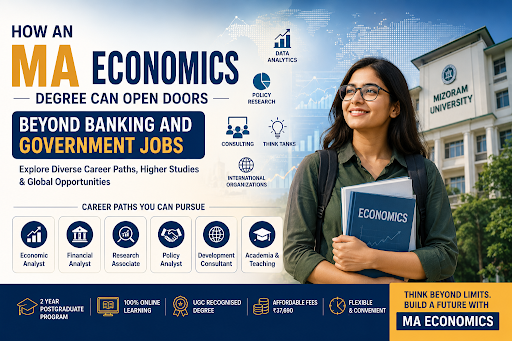
Ask most people what an economics postgraduate does for a living, and you'll hear the same two answers: they join a bank, or they sit for the civil services. Both are legitimate paths. Neither comes close to capturing what a postgraduate economics credential actually unlocks in today's professional landscape.
The gap between public perception and professional reality in economics is wider than in almost any other discipline. While students are busy preparing for IES examinations or researching RBI-grade positions, entire sectors, such as strategy consulting, data analytics, international development, policy think tanks, corporate research, fintech, and academic research, are actively hiring people with exactly the quantitative reasoning, data interpretation, and analytical modelling skills that a rigorous postgraduate economics programme builds.
The students who end up in the most interesting and best-compensated careers after an economics master's are not necessarily the ones who targeted the most obvious destinations. They are the ones who understood what the degree actually gave them: a way of thinking systematically about how resources, incentives, and institutions interact and found the broadest possible set of contexts in which that thinking creates value.
Table of Contents
- What a Postgraduate Economics Programme Is Actually Designed to Build
- The Natural Progression From an Economics Undergraduate Degree
- Inside the Curriculum: What Four Semesters of Economics Build
- The Texts That Shape How Economists Actually Think
- The Online Format and What It Changes for a Quantitative Discipline
- The Actual Range of Careers This Degree Unlocks
- What Comes After the Master's: Doctoral and Professional Pathways
- What the Degree Pays: A Realistic Range
- The Investment and How to Get In
- Who This Programme Is Right For and Who Should Think Carefully
- Where Economics Graduates Are Headed Over the Next Decade
- What to Take Away From This
- Frequently Asked Questions
What a Postgraduate Economics Programme Is Actually Designed to Build
The MA Economics course is a two-year postgraduate programme that takes a student with undergraduate-level economic understanding and develops their capacity to work with advanced theory, quantitative methods, and applied analysis at a professional level. The emphasis is on rigour: mathematical economics, econometrics, and research methodology are not supporting subjects; they are the spine of the programme.
What distinguishes a postgraduate economics postgraduate course from a simple extension of undergraduate study is the expectation of independent analytical judgement. At the undergraduate level, you learn what economic theories say. At the postgraduate level, you learn to evaluate whether those theories hold, under what conditions they break down, and how to build or modify frameworks when the standard models don't fit the problem at hand. That shift from learning to evaluating is what makes the master's graduate a fundamentally different kind of professional.
The MA Economics duration is two years across four semesters. This structure is deliberately paced: the first year builds advanced theoretical and quantitative foundations, while the second year moves into applied analysis, specialisation, and research. Students who engage with the programme as a progressive build, treating each semester as preparation for the next, extract significantly more from the degree than those who treat each semester in isolation.
| Programme Detail | Information |
|---|---|
| Programme | Master of Arts in Economics (Online) |
| Duration | 2 Years (4 Semesters) |
| Mode | Online |
| Eligibility | Bachelor's degree with Economics as a major or subsidiary subject |
| Total Fees | ₹37,690 |
| Regulatory Status | UGC-recognised central university programme |
| Admission Process | Application → Document Submission → Fee Payment → Confirmation |
The Natural Progression From an Economics Undergraduate Degree
For students considering MA Economics after BA Economics, the transition is the most direct path in the discipline and one that compounds undergraduate learning rather than starting over. The BA builds conceptual foundations and introductory analytical tools. The MA takes those foundations and applies advanced mathematical, statistical, and empirical methods to them. A student who engaged seriously with their undergraduate microeconomics, macroeconomics, and statistics will find the master's programme demanding but navigable. One who coasted through the undergraduate will find the first semester a significant shock.
The honest assessment for students deciding between entering the job market after a BA or continuing to a master's: the credential differentiation is real. Roles in economic analysis, research, consulting, and policy almost universally prefer or require a postgraduate qualification. For students who know they want to work at the intersection of data, policy, and business reasoning, the master's is not optional; it's the entry ticket.
The question of economics entrance exam requirements varies by institution. Many central universities with online postgraduate programmes admit students based on academic performance in their undergraduate degree rather than a separate entrance examination, making access more straightforward for working graduates and those who cannot travel for campus-based testing. Students should confirm the specific admission pathway at the time of application.
Ready to Take the Next Step?
Explore admissions, programme details, and student support through the links below:
Inside the Curriculum: What Four Semesters of Economics Build
The economics course subjects at the postgraduate level are architecturally different from undergraduate equivalents. Advanced Microeconomics at this level uses formal mathematical models, utility functions, game theory, and general equilibrium rather than intuitive explanations. Advanced Macroeconomics covers dynamic models of growth, monetary policy transmission, and business cycle theory. Econometrics introduces regression analysis, time series, and panel data methods that form the quantitative backbone of any applied economics role.
| Semester | Thematic Focus | Core Subject Areas | Analytical Capabilities Built |
|---|---|---|---|
| Sem I | Advanced Theory | Advanced Microeconomics, Advanced Macroeconomics, Mathematical Economics, Statistical Methods | Formal modelling, equilibrium analysis, quantitative reasoning |
| Sem II | Applied Economics | Econometrics, Development Economics, Public Finance, International Economics | Data analysis, policy evaluation, international trade thinking |
| Sem III | Specialisation & Policy | Indian Economy, Agricultural Economics or Industrial Economics, Research Methodology, Electives | Applied Indian context, sector-specific analysis, and research design |
| Sem IV | Research & Application | Dissertation / Project, Advanced Electives, Contemporary Economic Issues | Independent research, applied synthesis, professional-grade output |
The dissertation in Semester IV is the programme's most professionally consequential component and also the most underestimated by incoming students. An independently designed and executed research project with a clear research question, appropriate methodology, and defensible findings is the closest the degree comes to simulating the work of an actual economist. Students who treat the dissertation as a bureaucratic requirement tend to produce generic, forgettable work. Those who treat it as a professional portfolio piece, something that demonstrates their capacity for independent analysis to a future employer or admissions committee, tend to produce something that opens actual doors.
The Texts That Shape How Economists Actually Think
The economics books for master's level are substantially more demanding than undergraduate readings, and the relationship a student develops with these texts tends to determine how much depth they extract from the programme. Core theoretical texts include Varian's Microeconomic Analysis for advanced microeconomics, Romer's Advanced Macroeconomics for growth and business cycle theory, and Gujarati's Basic Econometrics as an entry point to applied quantitative methods. For students engaging with Indian economic contexts, the work of Pranab Bardhan, Kaushik Basu, and the NCAER and NBER working paper series provides essential applied grounding.
The most productive approach to postgraduate economics reading is not to read everything but to read core texts with enough depth to argue with them. Understanding why a model works and, more importantly, where it breaks down is what separates a graduate who has studied economics from one who thinks like an economist. The latter is what employers, research institutions, and further study programmes are selecting for.
The Online Format and What It Changes for a Quantitative Discipline
An Online Masters in Economics from a UGC-recognised central university carries the same regulatory standing as a campus-delivered equivalent valid for government employment, competitive examinations, further doctoral study, and international postgraduate applications. The credential signal comes from the institution and the UGC recognition, not from whether lectures were delivered in a physical room.
What changes in an online format for a quantitative programme is the learning environment for mathematical content. Economics at the postgraduate level involves significant formal reasoning, proofs, derivations, and model construction that benefit from active engagement rather than passive note-taking. Students pursuing an economics degree in India through an online route need to be especially deliberate about working through quantitative problems independently, not just following along with recorded lectures. The discipline of doing the mathematics, not just watching it done, is where the actual skill is built.
A pattern that emerges consistently among students who succeed in online postgraduate programmes in quantitative disciplines: they create structured study blocks, engage with assessments as learning tools rather than just evaluation checkpoints, and seek out peer groups or forums where they can discuss problems. The online format removes the ambient accountability of a classroom the students who replace it with self-imposed structure tend to perform at the same level as campus students; those who don't fall behind in ways that compound over semesters.
Explore Our Degree Options
The Actual Range of Careers This Degree Unlocks
The MA Economics career opportunities extend well beyond the two default answers most students default to. The analytical, quantitative, and modelling skills built through this programme are in demand across a range of sectors that are growing faster than the traditional banking and government tracks and, in many cases, paying significantly more.
| Sector | Entry-Level Roles | Mid-Career Growth |
|---|---|---|
| Financial Services & Banking | Credit Analyst, Research Associate, Risk Analyst | Senior Economist, Portfolio Manager, Risk Manager |
| Consulting & Strategy | Business Analyst, Economic Consultant (Junior), Strategy Associate | Senior Consultant, Strategy Manager, Practice Lead |
| Public Policy & Government | Research Officer, Policy Analyst, Government Economist | Senior Policy Advisor, IES Officer, Planning Commission roles |
| Data & Analytics | Data Analyst, Quantitative Analyst, Market Research Analyst | Data Scientist, Chief Analyst, Analytics Manager |
| International Organisations | Research Assistant (World Bank, IMF, UN bodies) | Economist, Programme Specialist, Senior Researcher |
| Academia & Research | Research Assistant, Junior Fellow, Teaching Associate | Lecturer, Associate Professor, Senior Research Fellow |
| EdTech & Think Tanks | Content Analyst, Policy Researcher | Research Director, Programme Lead, Senior Analyst |
Within this range, economics analyst job roles in research departments of banks, investment firms, consulting companies, and corporate strategy teams represent the largest immediate employment category for MA Economics graduates. These roles require the exact skills the programme builds: the ability to structure an economic question, gather and analyse relevant data, interpret findings in a business or policy context, and communicate conclusions to non-specialist audiences. The graduates who land these roles are not necessarily the highest academic performers; they are the ones who can demonstrate applied analytical thinking in an interview and through a work sample.
The second category worth understanding separately is economics research careers in think tanks, academic institutions, international organisations, and government research bodies. This track typically requires not just the master's degree but a demonstrable research output: a strong dissertation, a published paper or working paper, or a research fellowship. Students who intend to pursue this path should treat every research-oriented component of the programme, especially the dissertation, as portfolio-building, not coursework completion.
Learn More About Online Learning
What Comes After the Master's: Doctoral and Professional Pathways
For students who want to go further, higher studies in economics after the MA follow two main paths. The first is a PhD in economics, public policy, development studies, or a related quantitative social science. A PhD opens the academic and senior research track: faculty positions, senior fellowships at think tanks and international organisations, and roles in central bank research departments. The selection criteria for doctoral programmes are typically a strong MA performance, a clear research proposal, and demonstrable quantitative research skills, all of which the master's programme builds when engaged with seriously.
The second path is a professional qualification layered on top of the degree: CFA (Chartered Financial Analyst) for investment and financial research roles, or specialist policy programmes at institutions like IIM, ISI, or international equivalents. These combinations, MA Economics plus a professional qualification, are among the strongest credential profiles available in Indian financial and policy markets.
What the Degree Pays: A Realistic Range
The MA Economics salary range is one of the widest of any postgraduate discipline in India, which reflects both the range of sectors that employ economics graduates and the significant variation in compensation between those sectors. Government economists and academics tend to earn at the lower end of the range, but with job security and structured progression. Consultants, data analysts, and international organisation employees tend to earn at the higher end, with less structured but potentially faster progression.
| Role / Sector | Early Career (0–3 yrs) | Mid-Career (4–8 yrs) |
|---|---|---|
| Economic Analyst / Research Associate | ₹4–7 LPA | ₹9–15 LPA |
| Policy Analyst / Government Economist | ₹5–8 LPA | ₹10–18 LPA |
| Data / Quantitative Analyst | ₹5–9 LPA | ₹12–22 LPA |
| Consulting / Strategy | ₹6–10 LPA | ₹14–25 LPA |
| International Organisations (India-based) | ₹6–10 LPA | ₹15–28 LPA |
| Academia (Lecturer / Research Fellow) | ₹4–6 LPA | ₹8–14 LPA |
These ranges are indicative and based on broad market patterns. Actual compensation varies significantly by employer, city, specialisation, and individual performance. The most important variable is not which sector you enter but how quickly you build demonstrable skills and outputs that make the case for advancement. Economics graduates who can show a track record of analytical work reports, research, and data projects tend to progress faster than those who rely on the credential alone.
The Investment and How to Get In
The MA Economics fees for the two-year programme total ₹37,690. For a UGC-recognised central university postgraduate degree in a discipline with the career range described above, this represents one of the strongest cost-to-credential ratios available in Indian higher education. Students considering the fee in isolation should calculate it against the salary differential between roles that require the master's and those that don't. The break-even point is typically within the first year of employment.
| Step | Action | What It Involves |
|---|---|---|
| 01 | Fill the Application Form | Complete the online application with personal and academic details |
| 02 | Submit Documents | Upload undergraduate marksheets, identity proof, and a photograph |
| 03 | Pay the Admission Fee | Complete fee payment through the designated online gateway |
| 04 | Await Confirmation | Receive enrolment confirmation and programme access credentials |
Document preparation before starting the application prevents the most common admission delay: have your undergraduate degree certificate or provisional certificate, all semester marksheets, a government-issued identity document, and a passport-size photograph in digital format ready before beginning the form. Students in their final year of undergraduate study should confirm whether provisional admission is available while results are pending.
Who This Programme Is Right For and Who Should Think Carefully
Strong fit if:
- You have an undergraduate background in economics, mathematics, statistics, or a related quantitative discipline and want to deepen analytical and research capabilities
- You're currently working in finance, data, policy, or research and want a postgraduate credential that formalises and advances your professional positioning
- You're targeting roles in consulting, analytics, international development, or policy where a master's in economics is a standard or preferred qualification
- You intend to pursue doctoral study or senior research roles and need the master's as the standard prerequisite
Consider carefully if:
- You have limited comfort with mathematics and formal modelling, the programme is quantitatively demanding from Semester I, and discomfort with mathematics doesn't resolve itself through the degree
- You're expecting the credential alone to change your career trajectory without significant personal investment in building research and analytical outputs alongside the coursework
- You haven't clearly identified which part of the economics career range you're targeting. The programme is most valuable when pursued with a directional sense of what comes next
Where Economics Graduates Are Headed Over the Next Decade
The demand for economic reasoning in professional contexts is increasing, not decreasing, driven by the growing complexity of financial markets, the expansion of data-driven decision-making in government and business, and the increasing importance of policy analysis in a world where regulatory and geopolitical shifts are constant. The economist who can translate between formal analysis and actionable recommendations is among the most consistently valuable professionals across sectors.
What's changing is the tool set. The economics graduate of the next decade will be expected to be comfortable with data infrastructure, statistical software, and quantitative modelling in ways that previous generations weren't. The core analytical framework, understanding incentives, evaluating trade-offs, and modelling behaviour, remains constant. The delivery of that framework is increasingly computational. Students who invest in building quantitative and data skills alongside their master's coursework are positioning themselves for the version of economics careers that will dominate the next decade.
What to Take Away From This
📌 Key Takeaways
- The MA Economics is not a banking and government jobs degree it is a rigorous quantitative postgraduate qualification that opens careers in consulting, analytics, policy, research, international organisations, and academia, alongside the traditional tracks
- The two-year, four-semester structure builds from advanced theory in Year 1 to applied analysis and independent research in Year 2, with each semester a preparation for the next
- The dissertation is the most professionally consequential component of the programme; treat it as a portfolio piece, not a bureaucratic requirement
- At ₹37,690 total, the programme offers a highly competitive cost-to-credential ratio for a UGC-recognised central university postgraduate degree
- The online format carries the same regulatory validity as a campus programme. Eligibility for government employment, competitive examinations, and doctoral admissions is unchanged
- The highest career returns go to graduates who combine the degree with demonstrable analytical outputs, research, data projects, and published work, not to those who rely on the credential alone
Frequently Asked Questions
The standard eligibility is a bachelor's degree with Economics as a major or subsidiary subject from a recognised university. Students with backgrounds in Mathematics, Statistics, Commerce, or related quantitative disciplines may also be eligible, depending on the specific admission policy; it is worth confirming directly with the institution. Students without any economics background at the undergraduate level will find the postgraduate programme extremely difficult from the first semester, as the curriculum assumes foundational knowledge of microeconomics, macroeconomics, and basic statistical methods.
Admission requirements vary by institution and academic cycle. Many central universities offering online postgraduate programmes admit students based on undergraduate academic performance rather than a separate entrance examination, which simplifies access for working graduates and those who cannot attend campus-based testing. However, some institutions do require an entrance test or interview. The specific admission pathway should be confirmed directly with the university at the time of application, as policies can change between academic cycles.
The most common immediate employment tracks for MA Economics graduates are economic and research analyst roles in financial institutions, consulting firms, and corporate research departments; data and quantitative analyst positions in analytics-driven organisations; policy research roles in government departments, think tanks, and NGOs; and entry-level positions in international development organisations. Government economics roles through examinations like the Indian Economic Service are also a significant track. The breadth of options is wider than most students expect at the point of enrolment, and the direction chosen depends heavily on which components of the programme, quantitative methods, applied policy, and research the student engages with most deeply.
Yes. An MA in Economics from a UGC-recognised university is a standard prerequisite for doctoral admission in economics, development studies, public policy, and related quantitative social science disciplines. PhD programmes in India and internationally evaluate applicants on the strength of their postgraduate performance, the quality of a research proposal, and demonstrable research ability, typically evidenced by the dissertation and any published or working papers. Students who intend to pursue doctoral study should treat the master's dissertation as the first significant piece of their research portfolio and approach it accordingly.
The regulatory standing is equivalent: a degree from a UGC-recognised central university carries the same validity for government employment, competitive examinations, and further study regardless of whether it was delivered online or on campus. Career outcomes depend on what the graduate demonstrates in terms of analytical skills, research output, and relevant experience, rather than the delivery mode of their degree. The practical difference is in the learning environment: online students need to be more deliberate about building quantitative skills independently and creating the peer engagement that happens organically on campus.
Need Help Deciding on Your Next Career Step? We're Here to Guide You!

Chat with Us
If you're feeling unsure, our friendly and experienced counseling team is available to answer all your questions. No bots here—just real people dedicated to helping you make the right decision.

WhatsApp Assistance
Need quick advice on the go? Our experts are available 24x7 on WhatsApp to chat with you. Drop us a message anytime, and we’ll provide the information you need, all at your convenience.
WhatsApp Assistance
Give Us a Ring
Sometimes, a direct conversation is what you need to gain clarity. If you still have questions after chatting or messaging, give us a call. Our experts are here to provide 24x7 guidance tailored to your career path
Call Now