Ask five people how much an MBA costs and it is entirely possible to get five wildly different numbers, ranging from a modest annual figure to a sum that looks more like a home loan. Neither answer is wrong. The truth is that “MBA cost” is not one number at all; it is a spread that depends almost entirely on the format chosen, the specialisation picked, and how many of the hidden costs a candidate actually accounts for before signing up.
For a working professional exploring options without leaving their job, the real figure is often far more approachable than popular imagination suggests. This piece walks through what actually makes up the cost of an MBA, why the number has become such a source of anxiety for so many families, and how to read past the headline fee to understand what a programme genuinely demands, financially and otherwise.
Table of Contents
- Why This Worry Feels Bigger Than It Used To
- What “Cost” Actually Includes, Beyond the Fee Receipt
- The Range Nobody Talks About Openly
- Why the Fee Number Isn't the Whole Investment Story
- A Few Reasons the Fee Conversation Has Shifted This Year
- Cost Also Depends on What You Choose to Study
- How Parents Tend to Read the Same Number
- Reading the Number Correctly Before Deciding
- Where This Is Headed
- Frequently Asked Questions
Why This Worry Feels Bigger Than It Used To
Cost anxiety around postgraduate education is not new, but it has intensified for a specific reason: candidates today are far more aware of opportunity cost than earlier generations were. A career break to study full-time is no longer measured only in fees paid; it is measured against the salary, promotions, and provident fund contributions quietly lost during that gap. At the same time, inflation in campus-based programme fees, hostel charges, and relocation expenses has widened the gap between what a full-time degree costs and what a flexible, work-integrated one costs.
This is precisely why the cost conversation now needs more nuance than a single number on a brochure. A candidate comparing two programmes side by side without understanding what sits underneath each figure risks making a decision based on incomplete information.
What “Cost” Actually Includes, Beyond the Fee Receipt
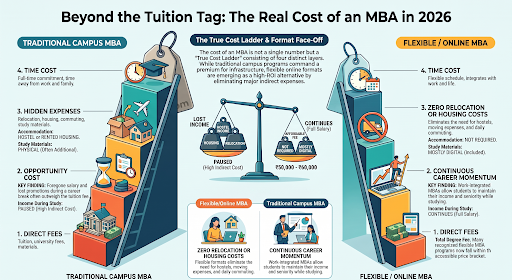
Most people equate MBA cost with tuition fee alone. In practice, the real financial picture is made up of four distinct layers, and skipping any one of them leads to an inaccurate estimate.
- Direct cost – Tuition, registration, examination, and study material charges
- Opportunity cost – Income foregone if the candidate has to pause working to study
- Hidden cost – Relocation, accommodation, commuting, and lifestyle adjustment expenses
- Time cost – The value of years spent studying instead of gaining work experience or seniority
Call this the True Cost Ladder. A candidate who only looks at the first rung is comparing programmes on a fraction of the real picture. Someone who climbs all four rungs before deciding is the one who ends up with a number that actually reflects what the degree will cost them, and what it is likely to return.
The Range Nobody Talks About Openly
Full-time, campus-based MBA programmes at well-known institutions can run into several lakhs of rupees once tuition, hostel fees, and living expenses are added together, sometimes stretching a family's budget for two full years. Flexible, work-integrated formats sit at the other end of the spectrum entirely. Many recognised online MBA programmes across specialisations are now priced in a considerably more accessible bracket, with total fees for many well-regarded programmes falling roughly between fifty and sixty thousand rupees for the full degree, a fraction of what a residential programme typically demands.
The table below breaks down where the actual difference in cost comes from, component by component, rather than leaving it as a single vague contrast.
| Cost Component | Flexible / Online-Format MBA | Traditional Campus MBA |
|---|---|---|
| Tuition fee | Typically lower, often a fraction of campus fees | Higher, especially at reputed institutions |
| Accommodation | Not required | Hostel or rented housing for programme duration |
| Relocation | Not required | Often required, adding moving and setup costs |
| Study material | Usually digital, included in fee | Physical materials, sometimes additional charges |
| Income during study | Continues, since candidate keeps working | Paused, adding a high indirect cost |
| Commuting | Minimal to none | Daily campus commuting or hostel-linked costs |
| Total effective cost | Considerably lower once all factors are combined | Considerably higher once all factors are combined |
Numbers aside, the pattern is consistent: the widest gap between formats is rarely in tuition alone. It is in everything that surrounds tuition, which flexible formats simply remove from the equation.
Why the Fee Number Isn't the Whole Investment Story
A lower fee only matters if the degree still delivers on outcomes, which is why cost cannot be evaluated in isolation from what it opens up professionally. Graduates typically move into roles such as:
- Business Development Manager
- Financial Analyst or Finance Manager
- Data and Business Analyst
- Marketing Manager
- Human Resources Manager
- Supply Chain and Logistics Manager
- Product Manager
- Management Consultant
- Entrepreneur or Founder
When the fee is modest, and the resulting role carries meaningfully higher earning potential, the arithmetic tends to favour the candidate very quickly, often well before the second year of the programme has ended.
Ready to take the next step in your career? Explore our UGC-DEB approved Online MBA programme.
Explore Online MBAA Few Reasons the Fee Conversation Has Shifted This Year
- Greater fee transparency – Universities are publishing detailed cost breakdowns rather than a single bundled figure
- Rising awareness of opportunity cost – Candidates increasingly account for lost income, not just tuition
- Wider acceptance of flexible formats – Employers no longer view work-integrated study as a compromise
- Specialisation-linked pricing – Fees increasingly reflect the tools and faculty expertise a specialisation demands
- Family-level financial planning – Parents are being brought into the cost conversation earlier and more transparently
Cost Also Depends on What You Choose to Study
Beyond format, the specialisation chosen influences both the fee structure and the eventual return, since some fields demand more specialised tools, case material, and faculty expertise than others.
Candidates drawn toward numbers and corporate strategy often gravitate toward a finance-focused MBA, where the coursework tends to be tool-heavy and closely tied to real market analysis. Details on how such programmes are typically priced can be explored here:
→ MBA Tuition Fees Vary by Specialisation
For those drawn to the analytical side of business, a specialisation built around data and analytics has quickly become one of the more sought-after paths, given how central data-informed decisions have become across industries. Programmes in this space are often evaluated closely on the return they generate relative to their cost:
→ Highest ROI MBA Programs
Candidates who see themselves building something of their own, rather than climbing an existing organisational ladder, often lean toward an entrepreneurship-oriented MBA, which tends to blend financial planning, venture strategy, and leadership development:
→ MBA for Future Business Leaders
Certain sectors are also seeing a visible rise in hiring appetite, and logistics and supply chain is one of them, driven largely by the growth of e-commerce and increasingly complex distribution networks:
→ Growing Demand in Logistics Sector
Candidates aiming for brand, communication, and consumer-facing roles typically consider a marketing specialisation, where coursework has shifted heavily toward digital channels and data-backed campaign decisions:
→ Best MBA for Marketing Professionals
And for those inclined toward organisational culture, talent strategy, and workplace policy, a people management specialisation continues to see steady demand as companies invest more deliberately in retention and leadership pipelines:
→ MBA for People Management Careers
How Parents Tend to Read the Same Number
Where a candidate often looks at cost through the lens of career return, a parent typically looks at it through the lens of family financial stability. A fee that seems reasonable to a working professional can still feel significant to a household managing multiple priorities at once. This is where the absence of relocation and income pause matters most, since it removes two of the highest indirect costs a family would otherwise have to absorb. A recognised, properly accredited programme that fits within a manageable fee bracket tends to resolve this concern faster than any amount of reassurance about career outcomes alone.
Reading the Number Correctly Before Deciding
The most useful way to approach the cost question is not to ask “is this expensive” but to walk it through the True Cost Ladder introduced earlier: What is the direct fee? What income, if any, is paused to pay it? What hidden costs come attached to the format chosen? And how many years of career momentum does the format allow the candidate to keep, rather than lose? A programme that scores well across all four questions is very likely to be a sound financial decision, regardless of how its headline fee compares to another programme's.
Where This Is Headed
Fee structures across postgraduate education are likely to keep diverging further along format lines rather than converging. Flexible, work-integrated programmes are expected to keep expanding access for candidates outside major cities, while campus-based programmes will likely continue commanding a premium tied to physical infrastructure, residential experience, and brand prestige. For most working professionals, this divergence is good news: it means the degree can increasingly be shaped around a candidate's financial reality rather than the other way around.
Frequently Asked Questions
Not necessarily. Value depends on accreditation, curriculum relevance, and how directly the degree connects to the candidate's career goals, not on fee size alone. A well-recognised, moderately priced programme can deliver a stronger return than an expensive one that doesn't align with the candidate's field.
Relocation, accommodation, commuting, and the income paused during full-time study are the most commonly overlooked costs. These often add up to far more than the tuition fee itself.
Yes, to some extent. Specialisations that require more specialised tools, software access, or faculty expertise can carry slightly different fee structures, though the difference is usually modest compared to the format-related cost gap.
Yes. Flexible and work-integrated formats are specifically designed to let candidates continue working while studying, which removes one of the largest indirect costs associated with a traditional programme.
A realistic budget should include the direct fee, any study material or exam charges, and a buffer for time management support, such as reduced overtime or temporarily lighter side commitments, rather than assuming the fee receipt is the full financial picture.
Need Help Deciding on Your Next Career Step? We're Here to Guide You!

Chat with Us
If you're feeling unsure, our friendly and experienced counseling team is available to answer all your questions. No bots here—just real people dedicated to helping you make the right decision.

WhatsApp Assistance
Need quick advice on the go? Our experts are available 24x7 on WhatsApp to chat with you. Drop us a message anytime, and we'll provide the information you need, all at your convenience.
WhatsApp Assistance
Give Us a Ring
Sometimes, a direct conversation is what you need to gain clarity. If you still have questions after chatting or messaging, give us a call. Our experts are here to provide 24x7 guidance tailored to your career path
Call Now