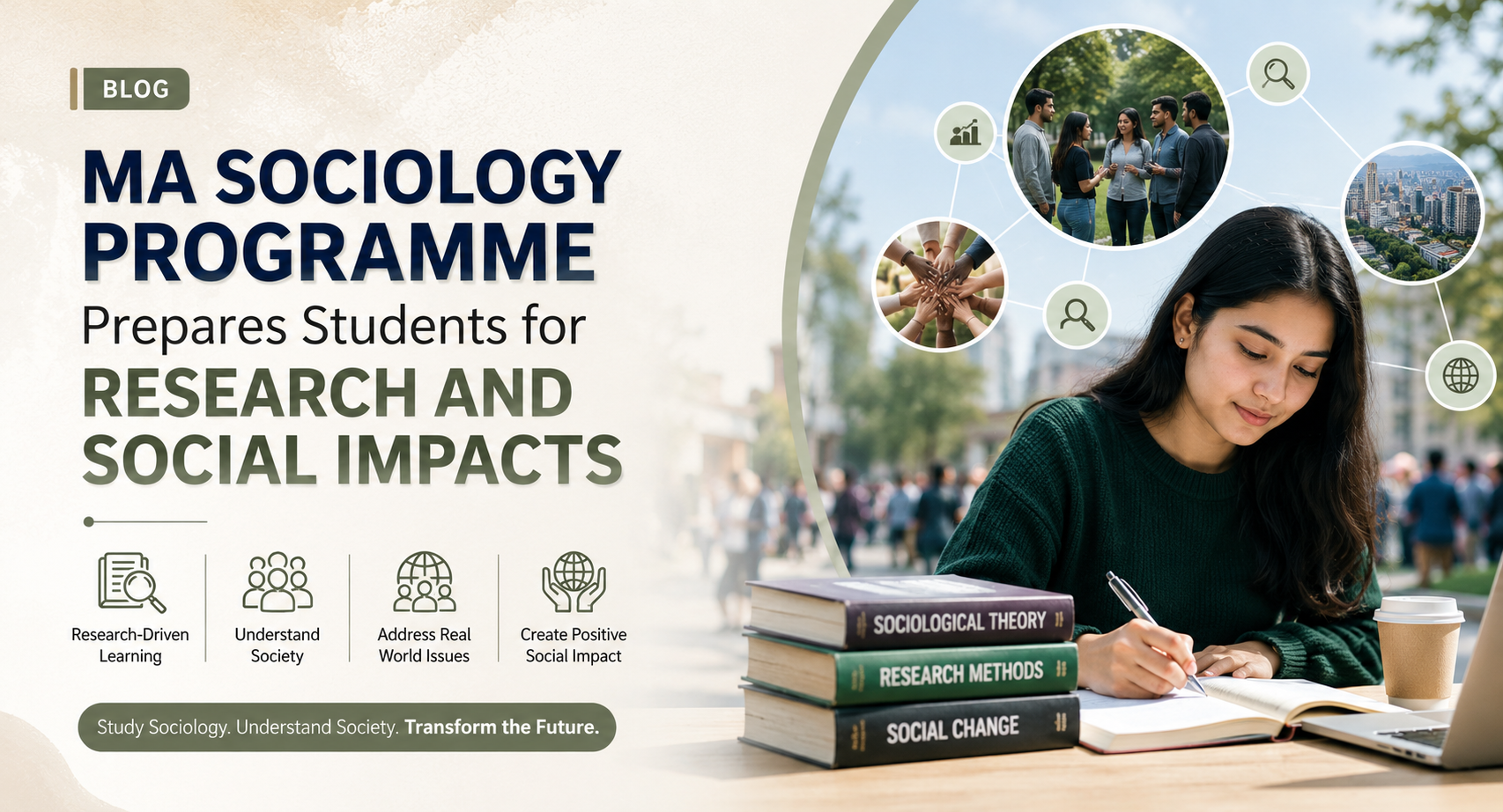
India is changing faster than its institutions can comfortably track. Urbanisation is reshaping communities that have existed in stable forms for generations. Climate change is producing migration patterns that social infrastructure wasn't designed to absorb. Digital technology is rewiring social relationships, information consumption, and political participation simultaneously. And underneath all of this, questions of caste, gender, religion, and class, which have never really been resolved, continue to shape life outcomes in ways that policy data alone cannot capture.
The discipline that exists to make sense of these patterns, to trace how social structures produce individual outcomes, how institutions reproduce inequality, how communities respond to disruption, is sociology. And the professionals who can apply that analytical lens to real problems: researchers, policy designers, development practitioners, journalists, HR strategists, and public administrators are in growing demand across precisely the sectors that are navigating this complexity.
What hasn't caught up with this demand is how students think about sociology as a career-building discipline. The perception that a sociology degree leads only to teaching or NGO work is a decade behind where the labour market actually is. The more accurate picture is of a discipline whose tools, systematic observation, structural analysis, research design, and evidence-based argument are increasingly recognised as professional assets across public, private, and international sectors alike.
Table of Contents
- Starting With the Basics: What This Qualification Actually Is
- Duration, Fees, and What the Programme Structure Looks Like
- Who Can Apply and What the Entry Criteria Signal
- What the Curriculum Actually Covers Across Four Semesters
- The Texts That Build Sociological Thinking at the Postgraduate Level
- Online MA Sociology: Why Online Delivery Works Particularly Well for a Social Science Discipline
- Choosing Where to Study: What Institutional Standing Actually Means
- The Analytical Depth the Programme Develops
- Where a Postgraduate Sociology Degree Actually Takes You
- What the Degree Pays: Ranges Across Sectors
- The Scope of This Degree in an Evolving India
- Getting In: What the Admission Process Looks Like
- Who This Programme Is Right For and Who Should Reconsider
- What to Take Away From This
- Frequently Asked Questions
Starting With the Basics: What This Qualification Actually Is
A surprisingly common question at the point of postgraduate enquiry is what does MA stand for in sociology, and it's worth answering properly, because the answer shapes expectations. MA stands for Master of Arts, the standard postgraduate academic qualification in humanities and social sciences. In sociology, the MA signals a two-year programme of advanced study in social theory, research methodology, and applied sociological analysis going significantly beyond the breadth of undergraduate coverage into depth, rigour, and independent research capacity.
The Master of Arts in Sociology is not a vocational training course and not a generalist social awareness programme. It is an academically rigorous postgraduate qualification that develops a graduate's capacity to analyse social phenomena systematically, design and execute research, interpret empirical evidence, and construct evidence-based arguments about how society functions. Those capabilities are what make the degree applicable across such a wide range of professional contexts.
The sociology masters degree is also a prerequisite for doctoral study in sociology and related social science disciplines, which opens the academic and senior research track. For students with a long-term orientation toward research, policy, or academia, the master's is not an endpoint; it is the foundation on which the more advanced layers of a career are built.
Duration, Fees, and What the Programme Structure Looks Like
The MA sociology duration is two years, structured across four semesters. This is the standard architecture for postgraduate social science programmes in India, and it is deliberately paced: the first year builds theoretical foundations and research design capacity, while the second year moves into applied analysis, contextual specialisation, and independent research. Students who engage with this progression, seriously treating each semester as preparation for the next rather than as an isolated module, extract significantly more depth from the degree.
The MA sociology fees for the full two-year programme total ₹37,690 from a UGC-recognised central university. For a postgraduate degree in a discipline with the career range described in this blog, this represents a highly competitive cost-to-credential ratio. Students weighing the investment should consider the salary differential between roles that require a postgraduate qualification and those that don't in most research, policy, and development sector roles, that differential is significant within the first three years of employment.
| Programme Detail | Information |
|---|---|
| Programme | Master of Arts in Sociology (Online) |
| Duration | 2 Years (4 Semesters) |
| Mode | Online |
| Eligibility | BA Sociology with 12 years of formal schooling plus a 3-year undergraduate degree, with a minimum of 40% marks from a recognised university or examining body |
| Total Fees | ₹37,690 |
| Regulatory Status | UGC-recognised central university programme |
| Admission Process | Application → Document Submission → Fee Payment → Confirmation |
Who Can Apply and What the Entry Criteria Signal
The MA Sociology admission eligibility requires a BA in Sociology with 12 years of formal schooling followed by a three-year undergraduate degree, and a minimum of 40% marks from a recognised university or examining body. The 40% threshold is intentionally accessible; this is not a programme designed to filter for academic high performers but to admit students who have demonstrated genuine engagement with the discipline at the undergraduate level and are ready to develop it further at a rigorous postgraduate standard.
Students who have completed their undergraduate degree in sociology with decent marks and are now deciding between entering the workforce or continuing to a master's are at the most consequential decision point. The case for continuing is straightforward in sociology specifically: the undergraduate degree opens limited doors independently, while the postgraduate degree, particularly from a UGC-recognised institution, opens the research, policy, and development sector doors that most sociology graduates are actually aiming for.
Ready to Take the Next Step?
Explore admissions, programme details, and student support through the links below:
What the Curriculum Actually Covers Across Four Semesters
The sociology course syllabus at the postgraduate level is architecturally layered it begins with the classical and contemporary theoretical canon in Semester I, moves into applied research methodology and social analysis in Semester II, contextualises learning within Indian social realities in Semester III, and culminates in independent research and applied synthesis in Semester IV. Each semester builds on the previous, which means the quality of engagement in early semesters directly determines the depth available in later ones.
| Semester | Thematic Focus | Core Subject Areas | Skills Built |
|---|---|---|---|
| Sem I | Sociological Thought | Classical Sociological Theory, Sociological Perspectives, Society & Social Change, Research Methodology I | Theoretical grounding, critical reading of social structures, foundational research design |
| Sem II | Applied Social Science | Contemporary Sociological Theory, Research Methodology II, Gender & Society, Economy & Society | Advanced research design, gender analysis, economic sociology, applied fieldwork thinking |
| Sem III | Specialisation & Context | Indian Society & Social Problems, Political Sociology, Sociology of Religion or Kinship, Elective I | Applied Indian social analysis, political institution critique, and comparative cultural reasoning |
| Sem IV | Research & Synthesis | Dissertation / Project, Sociology of Development, Elective II, Contemporary Social Issues | Independent research execution, development theory application, professional-grade analytical output |
The sociology research methods component spanning both Semester I and Semester II is the curriculum's most professionally critical thread. Research methodology in sociology is not a single subject but a set of tools: qualitative methods (interviews, ethnography, focus groups), quantitative methods (surveys, statistical analysis), and mixed methods that combine both. The ability to design, execute, and interpret a research study is what makes a sociology postgraduate useful to employers in research institutions, development organisations, policy bodies, and corporate research functions. Students who engage seriously with this component leave the programme with a genuinely deployable professional skill.
The Texts That Build Sociological Thinking at the Postgraduate Level
The best books for MA sociology span classical theory and contemporary application. The theoretical canon includes Anthony Giddens on structuration theory and social consequences of modernity; Pierre Bourdieu on capital, habitus, and field; and, for the Indian context, M.N. Srinivas on caste and village sociology, André Béteille on inequality and social structure, and G.S. Ghurye on Indian sociology's foundational debates. For research methodology, Norman Denzin and Yvonna Lincoln's Handbook of Qualitative Research is widely used alongside Earl Babbie's The Practice of Social Research for quantitative and mixed methods grounding.
A consistent pattern among students who develop genuine sociological thinking as opposed to those who complete the programme without it is how they read: not for summary but for argument. The question isn't what this theorist says but why they say it, what evidence do they rely on, where does their framework hold, and where does it break down? Students who bring that questioning stance to their reading tend to produce significantly stronger research and analysis than those who approach postgraduate texts as content to be memorised.
Online MA Sociology: Why Online Delivery Works Particularly Well for a Social Science Discipline
The sociology postgraduate degree delivered online from a UGC-recognised central university carries full regulatory validity for government employment, competitive examinations, doctoral admissions, and international further study applications. The credential's weight comes from the institution's UGC recognition, not from the physical location of instruction. Students concerned about the professional reception of an online degree in social sciences should note that in policy, research, and development sector hiring specifically, the credential and demonstrable analytical skills are the evaluation criteria, not whether lectures were attended in person.
What the online format demands from a social science student is deliberate engagement with qualitative material. Sociology is read, discussed, and argued with, but it doesn't resolve itself through worked examples the way mathematics does. Online students need to create the intellectual environment that campus students get by proximity: engaging actively with study material, forming peer discussion groups, participating in any live sessions available, and treating written assessments as genuine opportunities to develop and sharpen an argument.
Choosing Where to Study: What Institutional Standing Actually Means
The range of MA Sociology colleges in India spans central universities, state universities, deemed universities, and private institutions. For students evaluating options, the operative criteria are UGC recognition (which determines regulatory validity), the institution's academic reputation in social sciences (which affects how the degree is received by research organisations and further study programmes), and the quality of study infrastructure and curriculum design. Central universities with established social science departments tend to score well across all three.
What a sociology degree in India from a UGC-recognised central university provides, beyond the credential itself, is access to a research tradition, a body of scholarship, a set of methodological debates, and an intellectual community that shapes how the graduate thinks about social problems. This is what distinguishes a postgraduate degree in a social science from a professional certification: it isn't just training you for a role; it's training you to think in a particular way about a particular class of problems. That thinking capacity is what employers in policy, research, and development sectors are actually hiring for.
Explore Our Degree Options
The Analytical Depth the Programme Develops
The MA Sociology course details reflect a deliberate emphasis on both theory and application. Classical theory, Marx, Weber, Durkheim, provides the foundational analytical vocabulary: how capitalism shapes social relationships, how institutions gain authority, how social integration and anomie operate. Contemporary theory adds postcolonial, feminist, and poststructuralist perspectives that are essential for analysing Indian society where colonial history, caste hierarchy, and gender dynamics intersect in ways that Western theoretical frameworks alone cannot fully account for.
The applied layer of Indian society, political sociology, gender and society, and development sociology is where the theoretical tools are put to work on real social problems. This is where the discipline becomes professionally relevant: a graduate who can apply sociological analysis to questions of educational inequality, urban poverty, migration, or institutional corruption is producing the kind of insight that government departments, research organisations, and development agencies need and cannot get from data alone.
Where a Postgraduate Sociology Degree Actually Takes You
The MA Sociology Career Opportunities are wider than the academic and development sector defaults that most students assume. The combination of research design skills, theoretical analytical capacity, and applied social analysis that the programme develops is in demand across a surprising range of professional contexts, including corporate HR and diversity functions, media and journalism, public health research, urban planning advisory, and international organisation programme management.
| Sector | Entry-Level Roles (0–3 yrs) | Mid-Career Growth (4–8 yrs) |
|---|---|---|
| Social Research & Policy | Research Assistant, Policy Analyst, Survey Researcher | Senior Researcher, Programme Director, Policy Advisor |
| Development Sector & NGOs | Field Researcher, Programme Officer, M&E Associate | Programme Manager, Impact Analyst, Regional Director |
| Government & Public Administration | Social Welfare Officer, Community Development Officer | District Officer, Social Development Specialist, IAS/IPS (exam-based) |
| Corporate & HR | HR Analyst, CSR Officer, Diversity & Inclusion Coordinator | HR Business Partner, CSR Manager, People Strategy Lead |
| Media & Journalism | Social Affairs Journalist, Content Researcher, Fact-Checker | Senior Journalist, Editorial Analyst, Bureau Chief |
| Academia & Education | Research Assistant, Teaching Assistant, Junior Lecturer | Lecturer, Associate Professor, Senior Research Fellow |
| International Organisations | Programme Assistant (UN, UNICEF, WHO) | Programme Specialist, Country Director, Senior Advisor |
The MA Sociology jobs that attract the most competition and the best compensation are those at the intersection of research rigour and policy relevance: senior research roles in think tanks, programme specialist positions in international organisations, and policy analyst roles in government or consulting. These roles consistently select for graduates who can demonstrate not just theoretical knowledge but applied research output, a strong dissertation, a published working paper, or documented fieldwork experience. Students who build that output during the programme rather than after it tend to enter the job market with a meaningful advantage.
Learn More About Online Learning
What the Degree Pays: Ranges Across Sectors
The MA Sociology salary range reflects the breadth of sectors where the degree is applicable. Government and civil service roles offer structured pay scales with predictable progression and job security. International organisations offer the highest compensation but also the most competitive selection processes. The development sector spans a wide range from grassroots NGOs that pay modestly to large international development organisations that pay competitively. Corporate HR and CSR roles are increasingly well-compensated as companies take diversity, equity, and social impact measurement more seriously.
| Role / Sector | Early Career (0–3 yrs) | Mid-Career (4–8 yrs) |
|---|---|---|
| Social Researcher / Policy Analyst | ₹3.5–6 LPA | ₹8–14 LPA |
| Development Sector / NGO | ₹3–5 LPA | ₹7–13 LPA |
| Government / Civil Services | ₹5–8 LPA (structured scales) | ₹10–18 LPA |
| Corporate HR / CSR | ₹4–7 LPA | ₹9–16 LPA |
| International Organisations | ₹5–9 LPA | ₹14–25 LPA |
| Academia / Research | ₹3.5–5.5 LPA | ₹7–13 LPA |
These are indicative ranges based on broad market patterns. Actual compensation depends on the employer, location, specialisation, and the individual's demonstrated skills and outputs. The most consistent predictor of faster salary growth is demonstrable research and analytical output. Graduates who can show a portfolio of work, not just a credential, tend to negotiate better entry positions and progress more quickly through the early career stages.
The Scope of This Degree in an Evolving India
The MA Sociology Scope in India is expanding along three clear vectors. First, the formalisation of India's development sector, the increasing requirement for evidence-based programme design, monitoring and evaluation, and impact measurement, is creating sustained demand for social researchers with formal postgraduate training. Second, the corporate sector's growing investment in diversity, equity, and inclusion; CSR measurement; and stakeholder engagement is generating demand for graduates who understand social structures and can translate that understanding into organisational practice. Third, the policy sector's push toward data-informed governance using field research, community consultation, and social analysis to design better public programmes needs exactly the skill set this degree builds.
A pattern insight worth carrying: the sociology graduates who define the next decade of India's development and policy landscape will not be those who studied the discipline most narrowly. They will be the ones who combine sociological rigour with quantitative data literacy, who can move between field research and data analysis, between theoretical frameworks and practical recommendations. The postgraduate degree provides the foundation; building the digital and quantitative layer alongside it is the competitive edge.
Getting In: What the Admission Process Looks Like
| Step | Action | What It Involves |
|---|---|---|
| 01 | Fill the Application Form | Complete the online application with personal and academic details |
| 02 | Submit Documents | Upload undergraduate marksheets, degree certificate, identity proof, and photograph |
| 03 | Pay the Admission Fee | Complete fee payment through the designated online gateway |
| 04 | Await Confirmation | Receive enrolment confirmation and programme access credentials |
A practical preparation note: before beginning the application, have the following documents ready in clear digital format: all undergraduate semester marksheets, the degree or provisional certificate, a government-issued identity document, and a recent passport-size photograph. Students in the final semester of their undergraduate degree should check whether provisional admission is available while results are awaited.
Who This Programme Is Right For and Who Should Reconsider
Strong fit if:
- You have completed a BA in Sociology with at least 40% marks and want to develop genuine research and analytical depth in the discipline
- You are targeting careers in social research, public policy, development organisations, international bodies, or academia, where a postgraduate credential is expected or required
- You want to pursue doctoral study in sociology, social work, development studies, or public policy and need the master's as the standard prerequisite
- You are working in HR, CSR, journalism, or public administration and want to formalise and deepen your analytical framework with a recognised postgraduate degree
Consider carefully if:
- You have limited engagement with social theory at the undergraduate level. The postgraduate programme assumes foundational familiarity and moves quickly into advanced analytical territory
- You are seeking a highly structured vocational training pathway with a direct, narrow job outcome. Sociology is a generalist analytical discipline, and its career paths require active direction-setting by the graduate
- You are not prepared to invest seriously in the dissertation component. This is the most professionally valuable output of the programme and also its most demanding requirement
What to Take Away From This
📌 Key Takeaways
- The MA in Sociology is a rigorous two-year postgraduate programme that develops advanced theoretical, research, and applied analytical capabilities, not a general social awareness qualification
- Research methodology is the curriculum's most professionally deployable thread. Engage with it seriously across both semesters, it appears
- The career range extends well beyond teaching and NGO work: social research, policy analysis, corporate HR and CSR, international organisations, journalism, and public administration are all active destinations
- Eligibility requires a BA in Sociology with 40% marks from a recognised university. The threshold is inclusive, not restrictive
- At ₹37,690 total fees from a UGC-recognised central university, the cost-to-credential ratio is among the most competitive for a postgraduate social science degree in India
- The dissertation is the programme's most professionally significant output; treat it as a portfolio piece that demonstrates independent research capacity to future employers and doctoral admissions committees
Frequently Asked Questions
MA Sociology and MSW are related but distinct postgraduate qualifications.
MA Sociology is an academic degree focused on the theoretical and research dimensions of social science. It develops the capacity to analyse social structures, design research, and produce evidence-based analysis.
MSW is a professional degree focused on social work practice, counselling, case management, community intervention, and welfare service delivery.
MA Sociology graduates typically move into research, policy, academia, and development organisations.
MSW graduates move into social work practice, rehabilitation, community development, and welfare administration.
Yes. An MA in Sociology from a UGC-recognised central university is a valid qualification for appearing in the UGC NET (National Eligibility Test), which is the standard gateway to lectureship and junior research fellowship positions in Indian universities. Candidates who clear UGC NET after the MA are eligible to apply for assistant professor positions and can pursue JRF-funded doctoral research.
Yes. An MA in Sociology from a recognised university is the standard eligibility for PhD admission in sociology, development studies, social anthropology, public policy, and related social science disciplines. Doctoral programmes typically evaluate applicants on postgraduate academic performance, the quality of a research proposal, and demonstrated research capacity evidenced most strongly by the MA dissertation and any published or working paper output. Students intending to pursue doctoral study should treat the master's dissertation as the first piece of their research portfolio and invest in it accordingly, rather than treating it as a degree completion requirement.
MA Sociology graduates are eligible for a range of competitive examinations. UGC NET qualifies them for academic positions and junior research fellowships. UPSC Civil Services (IAS, IPS, IFS) and state PSC examinations accept sociology as an optional subject, which is a common choice for humanities postgraduates given the overlap with the curriculum. Social welfare and community development officer examinations conducted by state governments and public sector bodies also value a sociology postgraduate background.
The dissertation is an independently designed and executed research project completed in the final semester. Students select a research question, review relevant literature, choose an appropriate methodology qualitative, quantitative, or mixed collect and analyse data, and write up findings in a structured academic format. It is the most professionally significant component of the programme: it demonstrates to employers, research organisations, and doctoral admissions committees that the graduate can function as an independent researcher rather than just a course-completer.
Need Help Deciding on Your Next Career Step? We're Here to Guide You!

Chat with Us
If you're feeling unsure, our friendly and experienced counseling team is available to answer all your questions. No bots here—just real people dedicated to helping you make the right decision.

WhatsApp Assistance
Need quick advice on the go? Our experts are available 24x7 on WhatsApp to chat with you. Drop us a message anytime, and we’ll provide the information you need, all at your convenience.
WhatsApp Assistance
Give Us a Ring
Sometimes, a direct conversation is what you need to gain clarity. If you still have questions after chatting or messaging, give us a call. Our experts are here to provide 24x7 guidance tailored to your career path
Call Now