For professionals seeking to transition into analytics careers or advance within data-driven roles, an MBA in Big Data Analytics provides the combination of management education and technical analytical training that employers increasingly demand. Mizoram University's online programme makes this accessible to working professionals across India who cannot pause careers for campus study but recognise that data literacy and analytical capability are becoming non-negotiable for business leadership.
This guide addresses practical questions: what the programme covers, who can enrol, what technical skills are taught, what it costs, and what career opportunities it opens in India's rapidly growing analytics and business intelligence sectors.
Table of Contents
- What is an MBA in Big Data Analytics?
- Why Big Data Analytics Is a High-Demand Career
- Eligibility Criteria for MBA Analytics
- MBA Analytics Syllabus Overview
- Tools & Skills Covered
- MBA Big Data Analytics Fees
- Career Scope After an MBA in Analytics
- Job Roles & Salary Packages
- Who Should Choose This Program?
- Admission Process
- Conclusion
- FAQs
What is an MBA in Big Data Analytics?
An MBA specialisation in Big Data Analytics is postgraduate management education that combines core business training with technical expertise in data analysis, statistical methods, machine learning, and business intelligence. It is designed to produce managers who can lead data-driven decision-making in organisations — professionals who understand both business strategy and the analytical tools needed to extract insights from data.
The programme teaches graduates how to: use data to solve business problems across marketing, operations, finance, and strategy; build predictive models that forecast customer behavior, demand, or risk; communicate analytical findings to non-technical stakeholders in ways that drive business action; manage analytics teams and projects; and evaluate whether organizations are using data effectively or making decisions based on intuition when evidence is available.
This is not pure data science or software engineering — it is management education with analytical depth. Graduates are not primarily coding algorithms or building data infrastructure; they are using analytical tools to solve business problems, leading teams that work with data, and making strategic decisions informed by analysis rather than guesswork.
Programme positioning: This is management education for data-driven business roles, not technical data science training. It produces managers who can work with data and lead analytics initiatives, not pure technical specialists.
An MBA in Big Data Analytics combines core business training with technical expertise in data analysis, statistical methods, machine learning, and business intelligence to produce managers who can lead data-driven decision-making.
Why Big Data Analytics Is a High-Demand Career
The demand for professionals who combine business acumen with analytical capability is structural and accelerating. Organisations across sectors now generate enormous volumes of data — customer transactions, operational metrics, digital interactions, market data — and the competitive advantage belongs to those who can analyse it faster and translate insights into better decisions.
Business analytics roles are growing faster than almost any other business function. The shortage is not just data scientists who can build complex models — it is business managers who can frame the right analytical questions, interpret model outputs correctly, and apply insights to operational and strategic decisions. This profile — business-literate analytics professionals — is what the programme is designed to produce, and what hiring demand reflects.
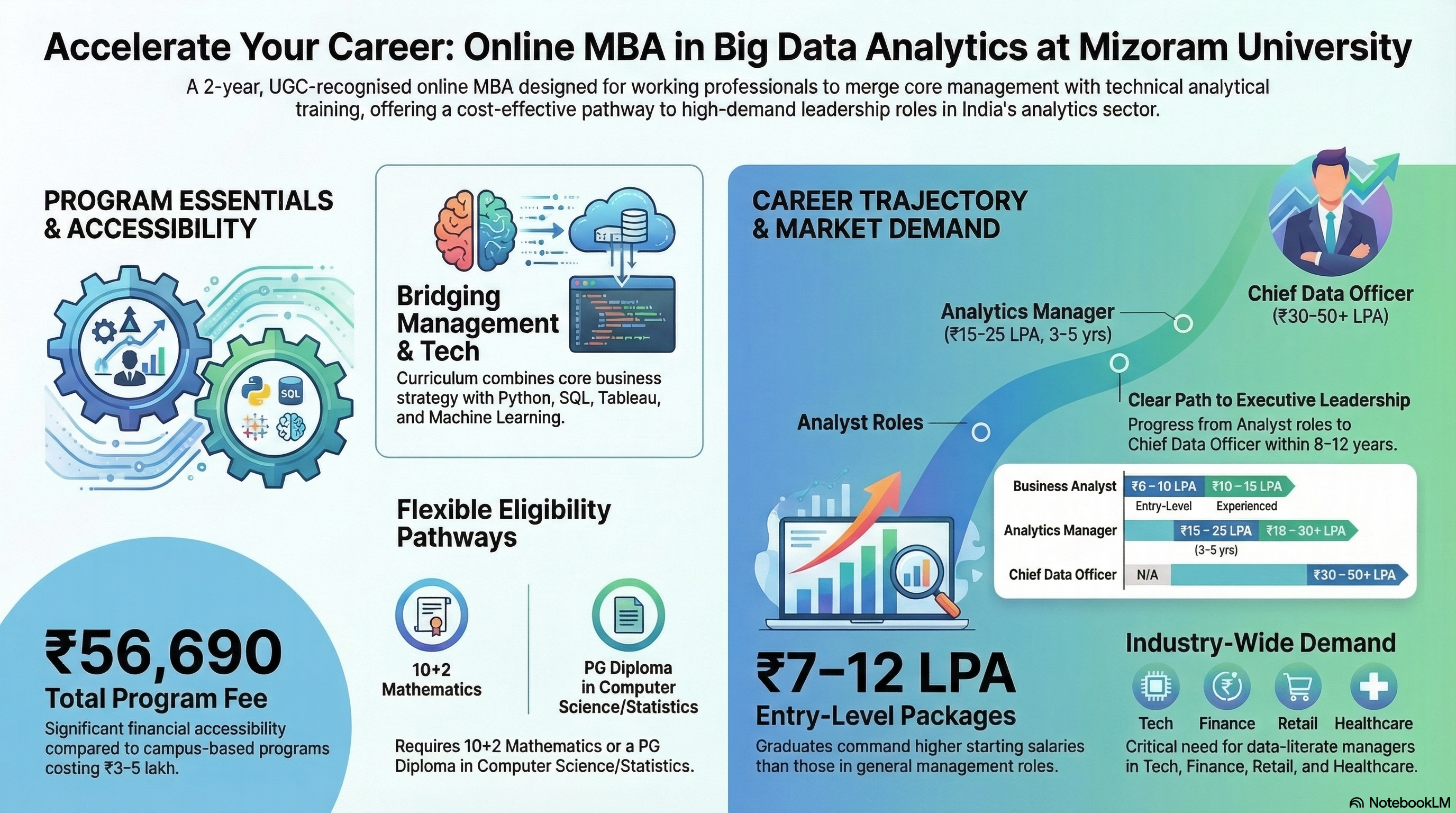
Salary premiums confirm the scarcity. Fresh graduates from credible analytics programmes command starting packages of ₹7–12 LPA, significantly higher than general management roles. With 3–5 years of experience, analytics managers earn ₹15–25 LPA. Senior roles in analytics leadership (Chief Data Officer, Head of Analytics) command ₹30–50 LPA. The compensation reflects a genuine market shortage of professionals who can manage analytics functions, not just execute technical tasks.
Demand drivers: Every business function now depends on data. Organisations need managers who can make data-driven decisions and lead analytics teams. This skill combination is rare, which drives both hiring demand and salary premiums.
Eligibility Criteria for MBA Analytics
The admission requirements are designed to ensure candidates have the foundational quantitative preparation needed to succeed in analytical coursework. There are two eligibility pathways:
- Standard Eligibility — Candidates who have completed any bachelor's degree or equivalent qualification through formal 10+2+3 academic progression from a recognised university or board, AND who have studied Mathematics at the Higher Secondary (10+2) level, are eligible for admission.
- Alternative Pathway for Technical Graduates — Candidates holding a postgraduate diploma in Computer Science or Statistics are eligible without requiring Mathematics at the Higher Secondary level. This recognises that technical postgraduate training provides equivalent quantitative preparation.
Eligibility summary: Mathematics at the 10+2 level is required unless you hold a postgraduate diploma in Computer Science or Statistics. This ensures all students have baseline quantitative skills needed for analytical coursework.
MBA Analytics Syllabus Overview
The curriculum is structured across two years and four semesters, combining core management education with specialised analytics training. The typical structure includes:
- Core Management Foundation — Courses in management principles, organisational behaviour, financial management, marketing management, operations management, and business strategy. These provide the business context that analytical work must serve.
- Statistics and Quantitative Methods — Probability, statistical inference, hypothesis testing, and regression analysis. This builds the mathematical foundation for understanding how data analysis works and when results are reliable.
- Data Management and Databases — How to work with databases, query data using SQL, clean and prepare datasets, and understand data structures. This is the operational foundation for working with business data.
- Business Analytics and Modelling — Applying statistical methods to business problems, building predictive models, forecasting demand, and evaluating business performance using data.
- Machine Learning Fundamentals — Introduction to supervised and unsupervised learning, classification, clustering, and how machine learning is applied in business contexts like customer segmentation and recommendation systems.
- Data Visualisation and Communication — Using tools like Tableau, Power BI, or Python libraries to create visualisations that communicate insights to non-technical stakeholders.
- Big Data Technologies — Introduction to distributed computing, cloud platforms, and tools for working with large-scale data that traditional analytics tools cannot handle.
- Analytics Strategy and Management — How to build analytics capabilities in organisations, manage analytics teams, and align analytical work with business priorities.
Curriculum balance: The syllabus combines business education with technical training in statistics, data analysis, and machine learning. Graduates can manage business functions while bringing analytical capability that most managers lack.
Tools & Skills Covered
The programme typically provides training in the industry-standard tools that analytics professionals are expected to know. While specific tools may vary by institution, the core skill set includes:
- Excel and Spreadsheet Analytics — Advanced Excel functions, pivot tables, statistical analysis, and financial modelling. Excel remains the most widely used analytical tool in business environments.
- SQL for Database Queries — Extracting, filtering, and manipulating data from databases. SQL is the baseline skill for working with business data stored in organisational systems.
- Python or R for Statistical Analysis — Programming for data analysis, statistical modelling, and machine learning. Python is more commonly taught due to its broader applicability; R is preferred in some statistical contexts.
- Tableau or Power BI for Visualisation — Creating dashboards, reports, and interactive visualisations that communicate analytical findings to business stakeholders.
- Statistical Software (SPSS, SAS, or equivalent) — Tools specifically designed for statistical analysis and modelling, commonly used in research and analytics teams.
- Big Data Platforms (Introduction) — Exposure to tools like Hadoop, Spark, or cloud platforms (AWS, Azure) that handle large-scale data processing.
Technical skills note: The programme teaches tools, but proficiency comes from practice. Students who invest time in hands-on projects and case studies graduate with portfolios that demonstrate capability, not just tool familiarity.
MBA Big Data Analytics Fees
The total programme fee for the two-year MBA in Big Data Analytics at Mizoram University is ₹56,690. This covers the complete programme, including study materials, examination fees, and access to learning resources.
This fee structure represents significant financial accessibility compared to campus-based analytics programmes, which often exceed ₹3–5 lakh when tuition, accommodation, and living costs are included. For working professionals, the online format provides both cost efficiency and the ability to continue earning during the degree, making the return on investment substantially higher than traditional programmes that require a career pause.
Fee clarity: ₹56,690 total for two years makes this one of the most financially accessible routes to a UGC-recognised analytics qualification. The modest investment produces strong returns through salary increases and career advancement.
Career Scope After an MBA in Analytics
The career pathways available to graduates span multiple business functions and sectors. Analytics professionals are needed in technology companies, financial services, retail and e-commerce, consulting firms, healthcare, manufacturing, and government.
Business analytics roles exist across functions: marketing analytics (customer segmentation, campaign optimisation), operations analytics (supply chain optimisation, demand forecasting), financial analytics (risk modelling, fraud detection), product analytics (user behaviour analysis, A/B testing), and strategic analytics (market analysis, competitive intelligence).
Career progression typically follows: entry as business analyst or data analyst (₹7–12 LPA), advancement to senior analyst or analytics lead (₹12–18 LPA within 3–5 years), then management roles as analytics manager or head of analytics (₹18–30 LPA), and ultimately executive positions like Chief Data Officer (₹30–50+ LPA) for those who combine technical capability with leadership skills.
Career trajectory: Analytics offers clear progression from analyst to management to executive roles over 8–12 years. Advancement requires continuous skill development — the field evolves rapidly, and professionals who stop learning plateau quickly.
Job Roles & Salary Packages
Understanding specific roles and realistic compensation helps students set career expectations and target skill development during the programme:
- Business Analyst (Analytics) — Analyses business data, identifies patterns, builds reports, and supports decision-making across functions. Entry salary: ₹6–10 LPA; with experience: ₹10–15 LPA.
- Data Analyst — Works with datasets to extract insights, build visualisations, and answer business questions using statistical analysis. Entry salary: ₹5–9 LPA; with experience: ₹9–14 LPA.
- Product Analyst — Analyses user behaviour, product performance, and market data to inform product development and strategy. Common in technology companies. Salary: ₹7–13 LPA.
- Marketing Analyst / Customer Analytics — Uses data to understand customer behaviour, segment audiences, measure campaign effectiveness, and optimise marketing spend. Salary: ₹6–12 LPA.
- Financial Analyst (Quantitative) — Builds financial models, conducts risk analysis, and uses data for forecasting and investment decisions. Salary: ₹7–14 LPA in financial services.
- Operations Analyst — Optimises operational processes, forecasts demand, manages inventory, and improves efficiency using data analysis. Salary: ₹6–12 LPA.
- Analytics Manager — Manages analytics teams, sets analytical priorities, and ensures insights translate into business action. Requires 3–5 years of experience. Salary: ₹15–25 LPA.
- Data Science Manager — Leads teams working on machine learning, predictive modelling, and advanced analytics projects. Salary: ₹18–30 LPA.
Salary reality: Salaries are highest in metros (Mumbai, Bangalore, Delhi NCR) and in technology, financial services, and consulting sectors. Entry-level roles pay ₹6–12 LPA; managerial roles reach ₹15–30 LPA with experience.
Who Should Choose This Program?
The programme is best suited for three profiles: working professionals in business functions who recognize that data literacy is becoming essential for career advancement and want to formalize their analytical skills; graduates with quantitative backgrounds (engineering, science, commerce, economics) seeking to enter analytics careers with management credentials alongside technical training; and mid-career professionals in non-analytical roles who want to transition into data-driven business functions and need both the credential and the skill set to make that shift credible.
The programme is less suitable for those seeking pure data science or machine learning engineering roles — that require deeper technical training than an MBA provides — or those expecting the degree alone to deliver employment without investment in hands-on practice and portfolio development during the programme.
Candidate profile: This is for professionals who want to work at the intersection of business and analytics, not for those seeking pure technical data science roles. Success requires both business thinking and a willingness to engage seriously with technical coursework.
Admission Process
The admission process for Mizoram University's online programmes is designed for remote completion. The steps are:
- Click Apply Now — Visit the official Mizoram University distance education admission portal and initiate your application by clicking Apply Now for the MBA Big Data Analytics programme.
- Fill in the Application Form — Complete the online form with accurate personal, academic, and contact information. Ensure a Mathematics qualification at 10+2 level is documented (or a postgraduate diploma in Computer Science/Statistics if applying through the alternative pathway).
- Submit the Required Documents — Upload scanned copies of your undergraduate degree certificate, mark sheets, 10+2 certificate showing Mathematics, identity proof, and recent photographs as specified in the admission notice.
- Pay the Application Fee — Complete payment of the application processing fee through the online payment gateway using credit/debit card, net banking, or UPI.
- Wait for Confirmation — The university reviews applications and verifies eligibility. Admission confirmation with student enrollment number and learning materials access is typically issued within 2–4 weeks.
Admission note: The entire process is online, making it accessible to applicants across India. Verify current admission dates and any updates to eligibility requirements directly with the university before applying.
Conclusion
The MBA in Big Data Analytics through Mizoram University offers working professionals a credible pathway to an analytics qualification without career interruption. At ₹56,690 for two years, it is financially accessible. With UGC recognition, it carries full credential validity across India. And with online delivery, it is logistically feasible for professionals who cannot relocate or pause employment.
The programme is not a shortcut to high salaries or guaranteed employment. It is a professional investment that positions holders for data-driven business roles that require both analytical capability and management judgment. For professionals seeking to transition into analytics careers, for those in business roles wanting to formalise data skills, and for graduates with quantitative backgrounds seeking management credentials alongside technical training, this provides both the qualification and the knowledge base that analytics hiring requires. The return on investment — financial, intellectual, and professional — is substantial for those who engage seriously with the coursework, build portfolios demonstrating capability, and apply the learning to their career contexts.
FAQs
Yes, if you engage seriously with the technical training and build demonstrable skills. Starting salaries of ₹7–12 LPA and progression to ₹15–25 LPA within 5 years reflect genuine market value. However, the degree alone is not sufficient — employers hire based on demonstrated capability through projects and technical interviews.
Career options include Business Analyst (₹6–10 LPA), Data Analyst (₹5–9 LPA), Product Analyst (₹7–13 LPA), Marketing Analyst (₹6–12 LPA), Financial Analyst (₹7–14 LPA), Operations Analyst (₹6–12 LPA), and Analytics Manager (₹15–25 LPA). These roles span consulting, technology, financial services, retail, e-commerce, and healthcare sectors.
Yes, but at a different level than software engineering. The programme teaches programming for data analysis — typically Python or R — focused on statistical analysis, data manipulation, and building models. The emphasis is on using code as a tool for analysis, not on becoming a professional programmer.
Entry-level salaries range from ₹6–12 LPA. With 3–5 years of experience, analytics professionals earn ₹12–18 LPA in senior analyst roles. Managerial positions reach ₹18–30 LPA. Senior leadership roles (Head of Analytics, Chief Data Officer) command ₹30–50+ LPA.
Yes, if you have Mathematics at the 10+2 level and are willing to learn programming and statistics from foundational levels. The programme is designed to be accessible to graduates from commerce, economics, business, and other quantitative backgrounds — not just computer science or engineering.
Need Help Deciding on Your Next Career Step? We're Here to Guide You!

Chat with Us
If you're feeling unsure, our friendly and experienced counseling team is available to answer all your questions. No bots here—just real people dedicated to helping you make the right decision.

WhatsApp Assistance
Need quick advice on the go? Our experts are available 24x7 on WhatsApp to chat with you. Drop us a message anytime, and we’ll provide the information you need, all at your convenience.
WhatsApp Assistance
Give Us a Ring
Sometimes, a direct conversation is what you need to gain clarity. If you still have questions after chatting or messaging, give us a call. Our experts are here to provide 24x7 guidance tailored to your career path
Call Now