For professionals in Mizoram and across India seeking to build careers in marketing, brand management, or business development, an MBA Marketing Online qualification provides both the management credential and the specialised marketing knowledge that employers increasingly demand. Mizoram University's programme makes this accessible to working professionals who cannot pause careers for campus study but recognise that formal marketing training is essential for progression beyond entry-level sales or operational roles.
This guide addresses practical questions: what the programme covers, who can enrol, what it costs, and what career pathways it opens in India's evolving marketing landscape, where digital capabilities are becoming as important as traditional marketing fundamentals.
Table of Contents
- What is an MBA in Marketing?
- Why Marketing Careers Are Growing in 2026–2030
- Eligibility for MBA Marketing
- MBA Marketing Subjects
- MBA Marketing Fees Structure
- Career Options After an MBA in Marketing
- Digital Marketing vs Traditional Marketing
- Salary After MBA Marketing
- Admission Process
- Conclusion
- FAQs
What is an MBA in Marketing?
An MBA specialisation in Marketing is postgraduate management education focused on how organisations understand customers, create value propositions, build brands, and drive sales. It combines core business training — finance, operations, strategy, organisational behaviour — with specialised coursework in consumer behaviour, marketing strategy, brand management, market research, and increasingly, digital marketing and analytics.
The curriculum teaches graduates how to: identify target markets and understand what customers value, develop marketing strategies that position products or services competitively, build and manage brands that command loyalty and premium pricing, design and execute marketing campaigns across traditional and digital channels, measure marketing effectiveness and optimise spending, and manage marketing teams and agency relationships.
This is not just advertising or sales — though those are components. It is strategic business training focused on how organisations grow revenue, acquire and retain customers, and build market position through understanding and serving customer needs better than competitors do.
Programme scope: Marketing management education covers strategy, consumer psychology, brand building, campaign execution, and measurement — not just creative advertising. It prepares graduates to manage marketing functions and drive business growth.
Why Marketing Careers Are Growing in 2026–2030
The demand for marketing professionals — particularly those with both traditional marketing knowledge and digital capabilities — is accelerating for structural reasons. Every business, regardless of sector, depends on acquiring and retaining customers. As competition intensifies and customer attention fragments across channels, organisations need sophisticated marketing capabilities to survive.
Digital transformation has expanded marketing's role. Twenty years ago, marketing meant advertising, brand management, and sales support. Today, it includes: customer data analysis and segmentation, digital advertising and social media management, content creation and SEO, email and automation marketing, customer experience design, and performance measurement using analytics. This expansion creates demand for marketing professionals who understand both strategy and execution across traditional and digital domains.
The shift from offline to online commerce accelerates hiring. E-commerce, digital services, and online customer engagement have made marketing the primary driver of business growth for many organisations. Companies that once competed on product quality or price now compete on marketing effectiveness — their ability to reach customers, communicate value, and create compelling buying experiences. This elevates marketing from a support function to a strategic priority, which means better compensation, more senior roles, and clearer career progression for marketing professionals.
Growth drivers: Marketing careers are growing because every business depends on customer acquisition, and digital channels have made marketing more measurable and strategic. The demand is structural and unlikely to reverse.
Eligibility for MBA Marketing
The admission requirements are designed to be inclusive while ensuring candidates have completed an undergraduate education. There are two eligibility pathways:
- Standard Eligibility — Candidates who have completed any bachelor's degree or equivalent qualification through formal 10+2+3 academic progression from a recognised university or board are eligible for admission. No minimum percentage is required, making the programme accessible to graduates from all academic backgrounds.
- Eligibility with Work Experience — Applicants with relevant professional experience of a minimum of two years receive relaxation in eligibility conditions for all postgraduate programmes. This recognises that sustained work experience demonstrates professional seriousness and provides a practical context that enhances postgraduate learning.
Eligibility summary: Any bachelor's degree qualifies you for admission. Two years of work experience provides additional eligibility flexibility and is valued as preparation for management study.
MBA Marketing Subjects
The MBA Marketing Syllabus is structured across two years and four semesters, combining core management education with specialised marketing coursework. The typical structure includes:
- Core Management Foundation — Courses in management principles, financial management, organisational behaviour, operations management, business strategy, and quantitative methods. These provide the general management knowledge all MBA graduates need.
- Marketing Management — Fundamentals of marketing strategy, the marketing mix (product, price, place, promotion), market segmentation and targeting, and positioning. This is the conceptual foundation for marketing practice.
- Consumer Behaviour — Understanding how consumers make purchasing decisions, what influences their choices, and how to design marketing that resonates with different customer segments.
- Brand Management — Building and sustaining brands, brand equity, brand positioning, and managing brand portfolios. Critical for careers in consumer goods, retail, and services.
- Digital Marketing — Online advertising, social media marketing, search engine marketing (SEM), search engine optimisation (SEO), email marketing, and content marketing. Essential for contemporary marketing roles.
- Marketing Research and Analytics — How to conduct market research, analyse customer data, measure campaign effectiveness, and use analytics to optimise marketing decisions.
- Sales and Distribution Management — Managing sales teams, designing distribution channels, and coordinating sales and marketing activities.
- Integrated Marketing Communications — Advertising, public relations, promotions, and how to coordinate messages across multiple channels for maximum impact.
Curriculum balance: The syllabus combines strategic marketing thinking with practical execution skills across traditional and digital channels. Graduates can manage marketing functions broadly, not just one specialisation.
MBA Marketing Fees Structure
The fees at Mizoram University are structured across two years with a transparent component breakdown:
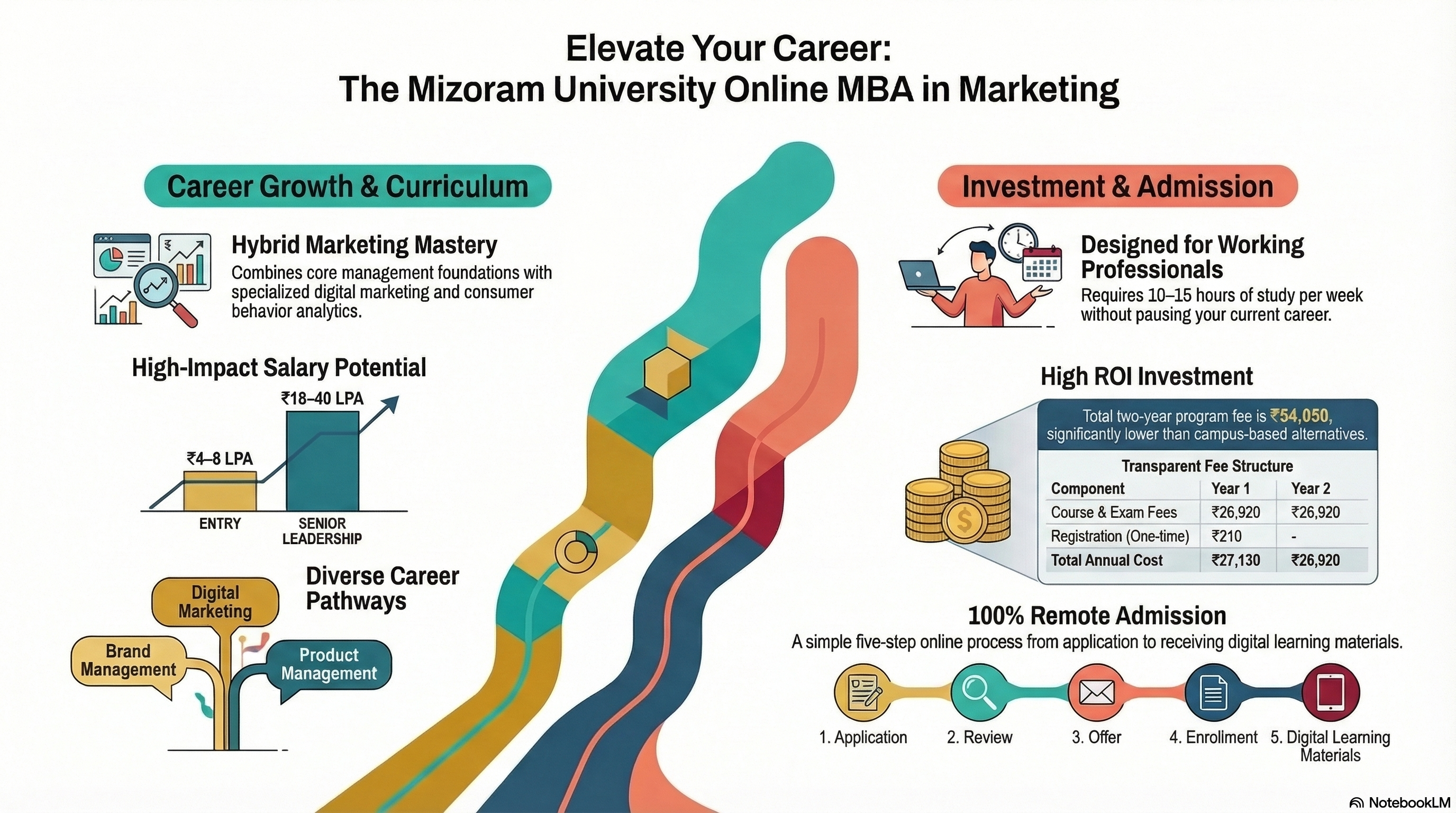
- Year 1: The first year includes a one-time registration fee of ₹210, examination fee of ₹2,500, and course fee of ₹24,420, bringing the total first-year fee to ₹27,130.
- Year 2: The second year includes an examination fee of ₹2,500 and a course fee of ₹24,420, totalling ₹26,920 for the year.
- Total Programme Cost: The complete two-year programme fee is ₹54,050.
This fee structure is substantially lower than campus-based programmes, which typically exceed ₹2–3 lakh when tuition, accommodation, and living costs are included. For working professionals, the online format provides both financial accessibility and the ability to continue earning during the degree, making the return on investment considerably higher than traditional programmes that require a career pause.
Fee clarity: ₹54,050 total for two years makes this one of the most financially accessible routes to a UGC-recognised management degree in marketing. The modest investment produces strong career returns.
Career Options After an MBA in Marketing
The MBA Marketing careers available to graduates span multiple business functions and sectors. Marketing professionals are needed in consumer goods, retail, e-commerce, technology, financial services, healthcare, hospitality, media, and consulting.
- Brand Manager — Manages brand strategy, positioning, and marketing initiatives for a product or product line. Salary: ₹6–12 LPA; senior roles ₹15–25 LPA.
- Digital Marketing Manager — Plans and executes digital marketing campaigns across social media, search, email, and content channels. Salary: ₹5–10 LPA; senior roles ₹12–20 LPA.
- Marketing Manager — Oversees marketing strategy and execution for a business unit, product category, or geographic region. Salary: ₹7–14 LPA; senior roles ₹15–30 LPA.
- Product Manager — Manages product development, positioning, and go-to-market strategy. Common in technology and consumer goods. Salary: ₹8–15 LPA.
- Sales Manager — Leads sales teams, sets targets, and coordinates sales and marketing activities. Salary: ₹6–12 LPA plus incentives.
- Market Research Analyst / Manager — Conducts research to understand markets, customers, and competition. Salary: ₹5–10 LPA; managerial roles ₹12–18 LPA.
- Content Marketing Manager — Develops content strategy, manages content creation, and measures content performance. Salary: ₹5–10 LPA.
- Social Media Manager — Manages social media presence, creates engagement strategies, and measures social performance. Salary: ₹4–8 LPA; senior roles ₹10–15 LPA.
- Marketing Consultant — Advises organisations on marketing strategy, campaign optimisation, and brand positioning. Salary: ₹8–18 LPA depending on client base.
Career pathways: Marketing offers diverse roles across brand management, digital marketing, product management, and consulting. Entry typically starts at ₹5–8 LPA, progressing to ₹12–20 LPA with 3–5 years of experience, and ₹20–35 LPA in senior management.
Digital Marketing vs Traditional Marketing
Understanding the relationship between MBA Digital Marketing Online training and traditional marketing fundamentals is essential for career planning. The table below clarifies the distinction:
| Dimension | Digital Marketing | Traditional Marketing |
|---|---|---|
| Reach | Global, unlimited geographic boundaries | Local or regional, limited by media distribution |
| Cost | Lower cost, measurable ROI, pay-per-click models | Higher cost, expensive ad placements, broad spending |
| Targeting | Precise audience targeting by demographics, behaviour, and interests | Broad targeting, limited precision |
| Measurement | Real-time analytics, detailed performance metrics | Difficult to measure, delayed feedback |
| Engagement | Two-way communication, instant feedback, and customer interaction | One-way communication, limited feedback |
| Speed | Campaigns launch instantly, and results are in hours or days | Longer lead times, weeks to months for campaigns |
| Flexibility | Easy to modify campaigns in real-time based on performance | Difficult to change once launched |
| Career demand | High and growing, digital skills are in shortage | Stable but declining, traditional roles are consolidating |
The practical implication for marketing careers: both skill sets matter, but digital capabilities are in higher demand and command salary premiums. Marketing professionals who understand traditional brand strategy and consumer psychology but who can also execute digital campaigns, interpret analytics, and optimise performance are the most competitive in hiring and the most valuable to organisations.
Digital vs Traditional: Digital marketing is not replacing traditional marketing — it is expanding what marketing does. The strongest careers combine strategic thinking (traditional strength) with digital execution and measurement capabilities.
Salary After MBA Marketing
Understanding realistic salary expectations helps students make informed career decisions. Marketing salaries vary by role, industry, location, and individual capability, but clear patterns exist:
Entry-Level Roles (0–2 years experience): Fresh graduates or those with minimal experience typically start at ₹4–8 LPA in marketing coordinator, assistant brand manager, or junior digital marketing roles. Salaries are higher in metros (Mumbai, Delhi NCR, Bangalore) and in high-spending sectors like consumer goods, e-commerce, and technology.
Mid-Level Roles (3–7 years experience): Marketing managers, brand managers, and digital marketing leads earn ₹8–18 LPA. At this level, demonstrated ability to drive results — increased sales, improved brand metrics, successful campaign execution — matters more than the degree alone.
Senior Roles (8+ years experience): Senior marketing managers, marketing heads, and chief marketing officers earn ₹18–40 LPA depending on organisation size and industry. At senior levels, strategic capability, leadership, and business impact determine compensation.
Geographic Variation: Salaries in tier-2 cities and Northeast regions are typically 25–40% lower than metro markets, but so is the cost of living. Many professionals start regionally for experience, then move to metros for senior roles and higher compensation.
Salary reality: Marketing careers offer strong earning potential but require demonstrating results. Entry salaries are modest (₹4–8 LPA), but progression to ₹12–20 LPA within 5 years is achievable for strong performers. Senior leadership exceeds ₹25 LPA.
Admission Process
The admission process for the Online MBA in Marketing Management at Mizoram University is designed for remote completion:
- Step 1: Visit the Official Portal — Access the Mizoram University distance education admission website and navigate to the MBA Marketing programme page.
- Step 2: Complete the Application Form — Fill in the online application with accurate personal, academic, and contact information. Ensure all fields are completed to avoid processing delays.
- Step 3: Upload Required Documents — Submit scanned copies of your undergraduate degree certificate, mark sheets, identity proof (Aadhaar/passport), and recent photographs as specified in the admission guidelines.
- Step 4: Pay Application and Programme Fees — Complete payment of the application fee and, upon admission confirmation, the first semester programme fee through the designated online payment gateway.
- Step 5: Receive Confirmation and Learning Materials — The university verifies applications and issues admission confirmation with the student's enrollment number and access to learning resources. This typically takes 2–4 weeks from submission.
Admission note: The entire process is online, making it accessible to applicants anywhere in India. Verify current admission dates and fee structure directly with the university before applying.
Conclusion
The MBA Marketing Aizawl programme through Mizoram University offers working professionals a credible pathway to a marketing qualification without career interruption. At ₹54,050 for two years, it is financially accessible. With UGC recognition, it carries full credential validity across India. And with online delivery, it is logistically feasible for professionals who cannot relocate or pause employment.
The programme is not a guarantee of marketing employment or rapid salary increases. It is a professional investment that positions holders for marketing roles that require both strategic thinking and execution capability. For professionals currently working in sales, business development, or operational roles seeking to transition into marketing management, this provides the credentials and knowledge base that hiring typically requires. For fresh graduates, the degree is most valuable when combined with internships, projects, or entry-level marketing experience that demonstrates practical capability alongside academic qualifications. The return on investment — financial, intellectual, and professional — is substantial for those who engage seriously with the coursework, build portfolios showing campaign work or strategic projects, and apply the learning to their career contexts.
FAQs
An MBA in Marketing can be valuable for freshers, but employers typically prefer candidates with internship experience, projects demonstrating creativity or analytical capability, or strong portfolios. The optimal path is to pursue the degree while simultaneously building practical experience through internships, freelance projects, or entry-level roles.
Yes — online and distance learning formats are explicitly designed for working professionals who cannot attend campus programmes. Mizoram University's programme is structured for remote study, with coursework, assignments, and examinations manageable alongside full-time employment. The credential carries full UGC recognition.
The total two-year programme fee is ₹54,050. Year 1 costs ₹27,130 (including ₹210 registration fee, ₹2,500 examination fee, and ₹24,420 course fee). Year 2 costs ₹26,920 (₹2,500 examination fee and ₹24,420 course fee).
Career options include: Brand Manager (₹6–12 LPA), Digital Marketing Manager (₹5–10 LPA), Marketing Manager (₹7–14 LPA), Product Manager (₹8–15 LPA), Sales Manager (₹6–12 LPA plus incentives), Market Research Analyst/Manager (₹5–10 LPA), Content Marketing Manager (₹5–10 LPA), Social Media Manager (₹4–8 LPA), and Marketing Consultant (₹8–18 LPA).
Yes — credible marketing programmes now integrate digital marketing as a core component of the curriculum. The syllabus typically includes online advertising, social media marketing, SEO, content marketing, email marketing, marketing automation, and digital analytics. Students should supplement coursework with practical projects and certifications.
Need Help Deciding on Your Next Career Step? We're Here to Guide You!

Chat with Us
If you're feeling unsure, our friendly and experienced counseling team is available to answer all your questions. No bots here—just real people dedicated to helping you make the right decision.

WhatsApp Assistance
Need quick advice on the go? Our experts are available 24x7 on WhatsApp to chat with you. Drop us a message anytime, and we’ll provide the information you need, all at your convenience.
WhatsApp Assistance
Give Us a Ring
Sometimes, a direct conversation is what you need to gain clarity. If you still have questions after chatting or messaging, give us a call. Our experts are here to provide 24x7 guidance tailored to your career path
Call Now