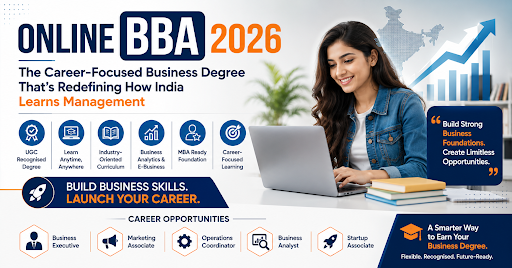
Something is shifting in how India's employers read a resume For the better part of a decade, the conversation around business education was dominated by two poles: the MBA for experienced professionals and the traditional campus BBA for fresh graduates who weren't sure what they wanted yet. That binary is breaking down.
The reason isn't philosophical; it's economic. India is producing more management-adjacent roles than ever before: operations coordinators, brand executives, business analysts, account managers, startup generalists, and growth associates. These roles don't require an MBA. They require structured business thinking, functional knowledge, and the ability to operate across departments. That profile is exactly what a well-designed undergraduate business programme builds.
The result is that the Bachelor of Business Administration is being re-evaluated not as a fallback degree before the 'real' qualification, but as a direct entry point to meaningful professional roles. What's changed is the quality signal attached to it. A BBA from a recognised, UGC-regulated institution now carries weight that a generic commerce degree doesn't. The employer isn't just seeing a degree; they're seeing three years of structured business training.
Table of Contents
- What a Business Degree Actually Trains You to Do
- Why the Online Format Creates a Different Kind of Graduate
- The Real Decisions Students Are Sitting With
- Three Years, Six Semesters: What the Structure Actually Looks Like
- What the Online BBA Is Designed to Deliver
- Who Should Seriously Consider This and Who Might Not Be Ready
- Getting In: What the Admission Process Actually Looks Like
- Where a BBA Graduate Stands in the 2025–2030 Job Market
- What to Carry Forward From This
- Frequently Asked Questions
What a Business Degree Actually Trains You to Do
There's a common misconception about what a BBA study involves. Most people assume it's a lighter version of an MBA, the same subjects, fewer years, less depth. That framing misses the point of what the undergraduate business programme is actually designed to accomplish.
A BBA is not a compressed MBA. It's a foundational programme that builds the professional vocabulary, analytical habits, and cross-functional awareness that make a graduate deployable across business contexts. Where an MBA goes deep into strategy and leadership, a BBA builds broad competence: you understand how finance connects to marketing, how operations interact with HR, how a business decision in one function creates consequences in another.
That cross-functional literacy is precisely what early-career business roles demand. A marketing executive who doesn't understand basic budgeting is limited. An operations associate who can't read a business report is dependent. A BBA graduate who has covered all of these domains even at an introductory level is structurally more useful to an organisation from day one than a specialist who only knows one corner of the business.
Why the Online Format Creates a Different Kind of Graduate
The online business administration degree is not a diluted version of campus learning; it is a different environment that, when designed well, produces a specific and valuable kind of graduate. The distinction is worth understanding before enrolment, not after.
Students who complete online business degree programs with rigorous assessment structures, industry-aligned curricula, and active academic support develop something that campus students often don't: deliberate learning habits. In a campus environment, a significant portion of learning happens passively through proximity to peers, attendance pressure, and face-to-face interaction with faculty. The online environment removes that scaffolding. The student who thrives is one who is self-directed, organised, and able to synthesise content without being prompted.
These are, notably, exactly the traits that employers value in early-career hires. The pattern across hiring managers in corporate environments is consistent: they prefer graduates who are self-sufficient, who can manage their own learning curve, and who ask good questions rather than waiting to be told what to do. An online graduate who has spent three years developing precisely those traits is, in a genuine sense, career-ready in a different way than a passive campus learner.
Ready to Take the Next Step?
Explore admissions, programme details, and student support through the links below:
The Real Decisions Students Are Sitting With
There are two types of students who arrive at this decision. The first is the Class 12 graduate who is weighing whether a three-year business programme is the right entry point into the professional world or whether they should wait for something 'bigger'. The second is the working student or career-switcher who wants a formal business credential without pausing their professional trajectory.
Both profiles share the same underlying anxiety: will this degree actually move my career forward, or will it just sit on a shelf? That anxiety is legitimate. Degrees that don't connect to real roles, real skills, and real professional contexts don't justify three years of investment.
The answer to that anxiety isn't reassurance; it's evidence. The structure of the programme, the rigour of the curriculum, the regulatory backing of the institution, and the specific career paths it connects to are the evidence. That's what the rest of this blog covers.
Three Years, Six Semesters: What the Structure Actually Looks Like
The BBA total years commitment is three years, structured across six semesters. This is the standard architecture for undergraduate business education in India, and it exists for a reason: the three-year arc allows for a meaningful progression from foundational knowledge to functional application to strategic synthesis.
Understanding the BBA year-by-year progression matters more than most students realise at the point of enrolment. What you study in Year 1 is not what you study in Year 3. The programme is layered; each year builds on the previous one, which means the value you extract from Year 3 depends on how seriously you engaged with Years 1 and 2. Students who treat the first year as orientation and only 'get serious' in Year 3 consistently underperform their peers who engaged from Semester I.
| Year | Focus | Core Subjects | Skills Built |
|---|---|---|---|
| Year 1 | Business Foundations | Principles of Management, Business Communication, Financial Accounting, Microeconomics, Business Statistics | Analytical thinking, business writing, quantitative reasoning |
| Year 2 | Functional Depth | Marketing Management, Human Resource Management, Corporate Finance, Organisational Behaviour, Business Law | Functional business decision-making, cross-domain awareness |
| Year 3 | Strategy & Application | Strategic Management, Entrepreneurship, International Business, Electives, Project Work | Strategic thinking, industry application, career-ready output |
For students planning ahead: BBA years of study translate directly into specific career readiness milestones. By the end of Year 1, you should be able to read a business context. By the end of Year 2, you should be able to work within a business function. By the end of Year 3, you should be able to think across business functions. That progression is what makes the BBA a career-building degree rather than just a credential.
What the Online BBA Is Designed to Deliver
The Bachelor of Business Administration is structured around a core principle: business education should produce graduates who understand organisations, not just business concepts. The difference is significant. Understanding a concept means you can define it. Understanding an organisation means you can see how the concept plays out in the real decisions a company makes every day.
The Bachelor of Business Administration Online offered through a UGC-recognised university carries regulatory credibility that matters for employment, further studies, and competitive examinations. For students considering whether an online degree will be taken seriously, the credibility question is answered at the institutional and regulatory level, not at the delivery format level. A degree from a recognised university that happens to be delivered online is the same credential as one delivered on campus.
What makes online BBA programs particularly well-suited to the current market is the alignment between what they produce and what employers are actually looking for. A student who completes a programme like BBA (E-Business) has covered core management principles, business analytics, e-commerce and even digital marketing at the undergraduate level. That's a profile that fits the broadest range of entry-level business roles, which is exactly what you want when you're starting a career and haven't yet committed to a specific domain.
Who Should Seriously Consider This and Who Might Not Be Ready
This programme is a strong fit if:
- You've completed Class 12 from any stream and want a recognised, career-oriented business degree without committing to a specific specialisation prematurely
- You're already working and want to formalise your business knowledge with a UGC-recognised undergraduate degree while maintaining your professional commitments
- You're planning to pursue an MBA and want a business undergraduate foundation that gives you stronger conceptual grounding before postgraduate study
- You're from a non-commerce background and want to pivot into business roles. The programme is designed to build from fundamentals, not assume prior knowledge
Pause and reconsider if:
- You're looking for a deeply specialised technical degree. The BBA is a generalist business foundation, not a specialised professional qualification
- You need intensive face-to-face interaction as your primary learning mode, the online format requires a level of self-direction that not every learner is ready for at 18
- You're expecting the degree alone to guarantee employment. It's a strong career accelerant when combined with skills, internships, and initiative, not a passive guarantee
Getting In: What the Admission Process Actually Looks Like
One of the consistent friction points in higher education is unnecessarily complicated admission processes. BBA admissions here are structured to be straightforward: four steps, no entrance examination requirement for the standard track, and a process that can be completed entirely online.
| Step | Action | What It Involves |
|---|---|---|
| 01 | Fill the Application Form | Complete the online application with personal and academic details |
| 02 | Submit Documents | Upload academic certificates, identity proof, and a photograph as specified |
| 03 | Pay the Admission Fee | Complete fee payment through the designated online payment gateway |
| 04 | Await Confirmation | Receive enrolment confirmation and programme access credentials |
A practical note on documents: the most common reason for admission delays is incomplete or unclear document uploads. Before starting the process, prepare scanned copies of your Class 10 and Class 12 marksheets, a government-issued ID, and a recent passport-size photograph. Having these ready before you begin the application form prevents the most common bottleneck.
Where a BBA Graduate Stands in the 2025–2030 Job Market
The demand trajectory for early-career business generalists in India is upward, driven by the expansion of the startup ecosystem, the formalisation of MSMEs, the growth of service-sector companies, and the increasing complexity of roles that used to be handled by a single person but now require structured knowledge to manage.
A pattern that's emerging in hiring is the preference for graduates who can 'speak business' across functions. A marketing hire who understands financial constraints makes better campaign decisions. An operations hire who understands HR dynamics manages teams more effectively. The three-year BBA curriculum, which deliberately spans all of these functions, is designed for exactly this profile.
Over the next three to five years, the biggest competitive edge for a BBA graduate won't come from the degree itself, but from how they've layered skills and experience onto the business foundation the degree provides. Internships, industry certifications, live projects, and early professional experience are the multipliers. The BBA provides the base on which all of those multipliers operate.
What to Carry Forward From This
📌 Key Takeaways
- The BBA is being re-evaluated by employers as a direct professional entry point, not a placeholder before 'real' qualifications
- The online format builds self-direction and deliberate learning habits that are genuinely valued in early-career professional contexts
- Three years, six semesters each year, have a distinct learning objective; engagement from Year 1 determines the value you extract from Year 3
- The credential carries weight because of institutional recognition and UGC regulation, not because of the delivery format
- The programme suits both fresh Class 12 graduates and working students looking to formalise your business knowledge
- Admission is a four-step process: apply, submit documents, pay fee, await confirmation with no entrance examination for the standard track
Frequently Asked Questions
The credibility of a degree is determined by the institution and its regulatory standing, not the format in which it is delivered. A BBA from a UGC-recognised central university delivered online carries the same validity as a campus-delivered degree from the same institution. What employers evaluate is whether the credential is from a recognised institution, whether the graduate has demonstrated relevant skills, and whether they can perform in the role. An online graduate who has built strong skills and practical exposure alongside their degree is evaluated on those merits, not on the modality of their classroom.
Yes, and in many cases, a BBA specifically prepares you more directly for an MBA than a non-business undergraduate degree. MBA entrance examinations test quantitative aptitude, verbal reasoning, and data interpretation, all areas that a BBA curriculum builds through subjects like business statistics, financial accounting, and business communication. More importantly, MBA interviewers at good institutions look for applicants who can demonstrate business thinking, not just academic scores. A BBA graduate who has spent three years developing that thinking across management, finance, marketing, and strategy is structurally well-positioned for postgraduate business education.
The academic content is designed to start from fundamentals; no prior business knowledge is assumed. What makes the online format challenging for some beginners is not the content but the structure: learning without a physical classroom requires self-organisation, consistent time management, and the ability to reach out proactively when you need support. The students who struggle are typically those who underestimate the first semester and try to catch up in the second.
Yes. Eligibility is open to students who have completed 10+2 from any recognised board, regardless of stream:
- Commerce
- Science
- Arts
- Vocational
The programme is built to accommodate learners without a prior business background, which is why the first year covers foundational concepts from first principles rather than assuming prior knowledge.
Non-commerce students sometimes find the transition to financial and quantitative subjects slightly steeper in the first semester, but this is a short adjustment curve rather than a structural barrier. The programme is designed to build you into a business thinker, not to filter for students who already are one.
Need Help Deciding on Your Next Career Step? We're Here to Guide You!

Chat with Us
If you're feeling unsure, our friendly and experienced counseling team is available to answer all your questions. No bots here—just real people dedicated to helping you make the right decision.

WhatsApp Assistance
Need quick advice on the go? Our experts are available 24x7 on WhatsApp to chat with you. Drop us a message anytime, and we’ll provide the information you need, all at your convenience.
WhatsApp Assistance
Give Us a Ring
Sometimes, a direct conversation is what you need to gain clarity. If you still have questions after chatting or messaging, give us a call. Our experts are here to provide 24x7 guidance tailored to your career path
Call Now