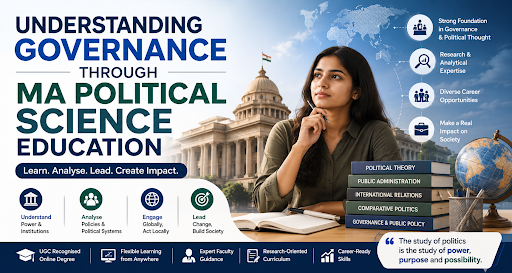
There is a peculiar contradiction at the centre of modern public life. Citizens are more exposed to political information than at any point in history. News cycles run around the clock, social media surfaces every policy debate, and global events land in people's feeds within minutes. Yet the general capacity to analyse, interpret, and act on that information has not kept pace. Opinions are plentiful. Understanding is rarer.
This is not simply a media problem. It is a structural one. The people who end up shaping policy, advising governments, managing public institutions, or working in civil society are, in most cases, those who were trained to think rigorously about power, governance, and political systems. That training has a name, and it is increasingly available to those who could not access it through conventional pathways.
The urgency of that access has rarely been clearer. From democratic backsliding in established republics to the governance challenges posed by climate policy, digital regulation, and geopolitical realignment, the decisions being made right now will be felt for decades. The question worth asking is: who is equipped to participate in shaping them?
Pattern Insight: In every period of significant political disruption, from the collapse of colonial structures to the post-Cold War order, the professionals best positioned to navigate and contribute were those with formal training in political systems, theory, and governance. That pattern is repeating itself now.
Table of Contents
- What Political Complexity Actually Demands
- The People Who Are Rethinking Their Direction
- Who Should Pursue This and Who Should Pause
- How Structured Education Responds to This Moment
- What the Curriculum Actually Covers
- Where Political Science Careers Are Heading: A 3–5 Year View
- Eligibility, Investment, and How to Enrol
- Key Takeaways
- Frequently Asked Questions
What Political Complexity Actually Demands
The surface-level reading of political events, who won, who lost, which party holds power, is something most people can follow. What requires training is the layer beneath: why institutions behave the way they do, how power is distributed and contested, what historical and ideological forces shape present decisions, and where policy logic breaks down under pressure.
This is the analytical layer that a serious political science postgraduate course is designed to build. It is not about memorising facts about governments. It is about developing a framework for interpreting political reality, one that holds up across different countries, different eras, and different kinds of crises.
One of the biggest gaps in public discourse today is the absence of this interpretive layer. Commentary is abundant; analysis is scarce. The professional who can bring genuine analytical depth to a policy question, an international negotiation, or an institutional design challenge is genuinely uncommon and genuinely valuable.
Contrarian Insight: Political science is often dismissed as a 'soft' discipline by those who have not studied it seriously. In practice, it is one of the most demanding analytical frameworks requiring the integration of history, philosophy, economics, law, and data interpretation. The professionals who master it are anything but soft.
The People Who Are Rethinking Their Direction
A certain kind of professional finds their way to political science education through a long arc rather than a direct path. The journalist who wants to report more rigorously on policy. The corporate professional who has grown interested in regulatory affairs. The social worker who wants to influence the systems that shape the lives of those they work with. The graduate who studied history or law and wants to extend that thinking into contemporary governance.
What these individuals share is not a single background it is a particular kind of restlessness. A sense that understanding how things work at the surface is not enough, and that the levers of change are buried deeper in political and institutional structures than most professional roles allow them to reach.
There is also a practical dimension. Many of these professionals have responsibilities, jobs, families, and financial commitments that make returning to full-time campus education impossible. The expansion of rigorous, well-structured MA Political Science online education has changed the calculation for this group significantly. The question of whether postgraduate political science education is accessible no longer has to be answered with a deferral.
Who Should Pursue This and Who Should Pause
Who should pursue this now:
- Graduates in political science, history, sociology, law, economics, or related disciplines who want to deepen their analytical and professional credentials
- Working professionals in government, public policy, NGOs, journalism, international organisations, or corporate affairs who want a structured framework to match their field experience
- Those interested in competitive examinations, civil services, diplomatic corps, and research fellowships where postgraduate-level political knowledge is a meaningful advantage
- Anyone who wants to move into roles in public administration, policy research, advocacy, or international affairs, but lacks the formal qualification to make that case to employers
Who should consider alternatives:
- Those whose primary interest is law, a law degree or an LLM is a more targeted credential for legal practice, even in public law
- Professionals seeking business or management roles who want some public policy exposure, a single elective or short course may be more proportionate than a full postgraduate degree
What happens if the decision is postponed?
Political science careers are not uniformly accessible to those without postgraduate credentials. Research roles, senior advisory positions, and roles in international organisations consistently require postgraduate-level qualifications. The longer the gap between undergraduate education and postgraduate development, the harder it becomes to re-enter the academic environment with the same intensity. In most cases, the better time to act is earlier when the professional trajectory can still be shaped by the qualification rather than constrained by its absence.
Decision Insight: The professionals who end up in meaningful governance and policy roles almost always made a decision to invest in their analytical foundation earlier than their peers. The window between undergraduate study and mid-career is when that investment has the highest return.
How Structured Education Responds to This Moment
The case for a Master of Arts in Political Science is not simply that it makes a professional more employable, though it does. The deeper case is that it changes the quality of thinking brought to political and governance questions. It installs a vocabulary, a methodology, and a set of analytical frameworks that remain useful across a lifetime of professional engagement with public affairs.
A well-designed programme at this level does not treat political science as a collection of facts to be absorbed. It treats it as a discipline with its own epistemological commitments, its own debates, and its own ways of posing and answering questions. That disciplinary rigour is what separates a postgraduate qualification from general reading, however extensive.
For those considering a political science masters degree through an online format, the key is to evaluate whether the programme maintains that rigour rather than diluting it for convenience. The best online programmes preserve the analytical demand of the discipline while removing the logistical barriers that historically made it inaccessible.
What the Curriculum Actually Covers
The political science course details in a well-structured postgraduate programme move across several interconnected domains, each building a different dimension of the analytical toolkit that political science professionals bring to their work.
Political Theory and Philosophy
The study of political theory subjects forms the intellectual foundation of the discipline. This includes classical traditions from Aristotle and Machiavelli to Locke, Rousseau, and Mill, as well as contemporary debates in justice, democracy, rights, and legitimacy. The application is direct: every policy argument rests, explicitly or implicitly, on political philosophical commitments. Understanding those commitments allows a professional to engage with policy debates at their root rather than their surface.
Comparative Politics and Governance
Comparative analysis builds the capacity to study how different political systems, presidential and parliamentary, federal and unitary, democratic and authoritarian, function and fail. This is essential for anyone working across multiple national contexts, advising on institutional design, or analysing why policies succeed in some settings and collapse in others.
International Relations
The international relations course thread within a political science programme covers the theoretical frameworks of realism, liberalism, constructivism, and critical theory that govern how states and non-state actors interact. It extends into contemporary issues: multilateral governance, security architecture, trade regimes, and the political dimensions of climate and technology. For professionals working in international organisations, foreign affairs, or globally operating NGOs, this is foundational rather than supplementary.
Public Administration and Policy
The public administration studies component addresses how governments are organised, how policy is formulated and implemented, and where institutional design succeeds or breaks down. This is arguably the most directly applied part of the curriculum relevant to civil servants, development professionals, consultants working with government, and anyone engaged in advocacy or public affairs.
Research Methods and Political Analysis
Postgraduate political science requires engagement with both qualitative and quantitative research methods. This builds the capacity to evaluate evidence, design research, and contribute to the scholarly and policy literature. It is also increasingly valued in applied roles where data-informed advocacy and evidence-based policymaking are becoming standard expectations.
Students and practitioners often supplement their formal study with established works from the field. Core political science book collections from canonical texts to contemporary policy analyses form a reading ecosystem that extends well beyond the classroom and supports lifelong professional development.
Where Political Science Careers Are Heading: A 3–5 Year View
Governance Complexity Is Creating Specialist Demand
The policy challenges of the coming years, digital governance, climate policy, demographic change, and geopolitical realignment are not problems that can be managed by generalists alone. They require people who understand the political economy of change: how institutions resist reform, how coalitions form, how international agreements get made and broken. That expertise lives primarily in the political science tradition.
The Online Political Science Degree Gains Professional Legitimacy
The credibility of the online political science degree has shifted substantially. Employers in government, international organisations, research institutions, and the private sector are increasingly indifferent to whether a postgraduate qualification was earned on campus or online, provided the institution is recognised and the programme is rigorous. The access advantage of online education is now matched by professional parity.
Civil Services and Competitive Examinations Remain a Primary Pathway
For a significant proportion of political science graduates, the civil services IAS, IFS, IPS) and state services remain the most prestigious career channels. Postgraduate political science study strengthens both the subject-matter preparation and the analytical writing skills that competitive examinations demand. The alignment is direct and well-established.
Future Projection: As governance challenges become more technically complex and globally interconnected, the demand for professionals with formal political science training will grow, not diminish. The discipline that once seemed abstract is increasingly the most relevant framework for understanding the decisions that will define the next decade.
Eligibility, Investment, and How to Enrol
Who Is Eligible
The political science entrance eligibility for this programme requires a Bachelor of Arts in Political Science, completed through a formal 10+2+3 academic structure, with a minimum of 40% marks from a recognised university or academic body. The programme is designed for graduates who want to extend their disciplinary foundation into advanced study. No additional entrance examination is required.
Total Programme Investment
The total fee for the programme is Rs 37,690, structured to make postgraduate political science education accessible to graduates who may not be in a position to take on the financial burden of full-time residential study.
MA Political Science Admission: The Process
Admission follows a four-step process designed to be straightforward and manageable:
| Step | Action | What It Involves |
|---|---|---|
| 01 | Fill in the Application Form | complete the online application with your academic and personal details |
| 02 | Submit the Documents | upload your qualifying degree certificate, and identification documents |
| 03 | Pay the Admission Fee | confirm your place by completing the fee payment |
| 04 | Wait for Confirmation | receive your admission confirmation and programme onboarding information |
The MA Political Science admission 2026 cycle is open to eligible graduates. The process requires no entrance test; selection is based on academic eligibility alone.
Key Takeaways
📌 Key Takeaways
- Political science is not an abstract academic exercise it is the discipline that produces the professionals who understand and shape governance, policy, and institutional change
- The analytical demand of postgraduate political science study builds capabilities, interpretive rigour, research methodology, and theoretical fluency that are transferable across public, private, and civil society careers
- The range of political science career opportunities is broader than most people assume: civil services, international organisations, policy research, journalism, corporate affairs, the development sector, and academia are all realistic trajectories
- Online postgraduate political science education now carries the same professional weight as campus study and is significantly more accessible to working graduates
- The decision to pursue postgraduate education is most valuable when made before career ceilings form, not after
Frequently Asked Questions
The range of MA Political Science jobs available to graduates spans several sectors.
In the public sector, typical roles include policy analyst, research officer, civil service positions, legislative assistant, and public affairs manager. In the international sphere, graduates work with UN agencies, foreign ministries, embassies, and international NGOs.
In the private sector, roles in government relations, regulatory affairs, and corporate public policy have grown significantly. Research institutions and think tanks also represent a strong employment pathway for graduates with research skills.
Yes, provided the institution is recognised and the programme is well-structured. The shift toward online postgraduate education has been accompanied by significant improvements in programme design, assessment quality, and institutional recognition. For disciplines like political science, where much of the learning involves reading, writing, and analytical engagement with ideas, the online format is particularly well-suited.
The programme is specifically designed for graduates with a BA in Political Science as their undergraduate foundation. This ensures that postgraduate study builds meaningfully on prior disciplinary knowledge rather than covering introductory ground. Graduates from adjacent disciplines, such as history, sociology, law, economics, or public administration, who have significant exposure to political science content may wish to confirm their eligibility directly with the admissions team.
Postgraduate political science study aligns closely with the demands of competitive civil service examinations in India. The curriculum covers political theory, Indian governance, comparative politics, international relations, and public administration, all of which are directly relevant to UPSC and state service examination syllabi.
Self-study through books, articles, and online resources can develop general political awareness. Postgraduate study does something different: it instils a disciplinary framework, a structured way of posing questions, evaluating evidence, and building arguments that independent reading rarely achieves on its own.
Need Help Deciding on Your Next Career Step? We're Here to Guide You!

Chat with Us
If you're feeling unsure, our friendly and experienced counseling team is available to answer all your questions. No bots here—just real people dedicated to helping you make the right decision.

WhatsApp Assistance
Need quick advice on the go? Our experts are available 24x7 on WhatsApp to chat with you. Drop us a message anytime, and we’ll provide the information you need, all at your convenience.
WhatsApp Assistance
Give Us a Ring
Sometimes, a direct conversation is what you need to gain clarity. If you still have questions after chatting or messaging, give us a call. Our experts are here to provide 24x7 guidance tailored to your career path
Call Now