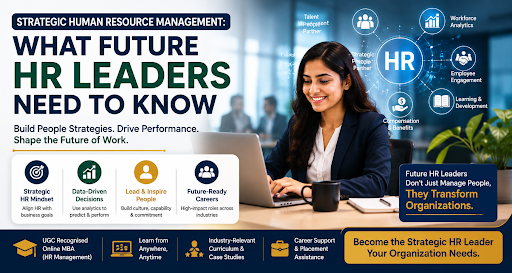
Here is the tension that most HR conversations quietly avoid: organisations are investing heavily in people strategy, yet the gap between what HR teams deliver and what business leaders actually expect has never been wider. Boards speak in the language of workforce agility, skills intelligence, and predictive talent decisions. Many HR teams are still responding with spreadsheets and annual appraisals.
This is not a skills gap in the traditional sense. It is a strategic positioning gap, and it is reshaping what employers look for when they hire, promote, or develop HR professionals. The question is no longer whether you understand HR. The question is whether you understand business well enough to make workforce decisions that move financial outcomes.
For anyone thinking about where HR leadership is headed, that distinction matters more than any job description or course brochure.
Pattern Insight: Organisations that treat HR as a compliance function consistently underperform on talent retention and productivity metrics compared to those where HR operates as a strategic partner at the leadership table.
Table of Contents
- What This Shift Actually Means
- The Dilemma Most HR Professionals Are Sitting With
- Who Should Pursue This and Who Should Wait
- How a Structured Programme Responds to This Gap
- What the Curriculum Actually Builds
- Where HR Leadership Is Headed: A 3–5 Year View
- Eligibility, Investment, and How to Get Started
- Key Takeaways
- Frequently Asked Questions
What This Shift Actually Means
The rise of data-driven HR, AI-assisted hiring, and workforce planning tools has not eliminated the need for human judgement; it has raised the bar for it. An HR professional who cannot read a workforce analytics dashboard or translate attrition trends into a business case is increasingly difficult to justify at the senior level.
What is changing underneath the surface is the expectation of translation. HR leaders are now expected to take a business problem, declining sales performance, high absenteeism in a specific unit, inability to attract mid-level tech talent and engineer a people-centred response. That requires not just HR knowledge, but commercial acumen, data literacy, and the ability to influence decisions at the executive level.
A common pattern in organisations that have made this transition successfully: their senior HR professionals do not see themselves as HR specialists first. They see themselves as business leaders who happen to specialise in people. That mindset shift is subtle, but the career outcomes are dramatically different.
Contrarian Insight: The most in-demand HR roles today are not going to people who know more HR theory. They are going to people who can use HR as a lever to solve business problems. The knowledge base is a starting point, not the differentiator.
The Dilemma Most HR Professionals Are Sitting With
Spend time in any HR forum or professional network, and a few recurring dilemmas surface quickly. The early-career HR professional who is good at their job but cannot seem to break into strategic roles. The mid-career generalist who senses the industry is moving but is not sure in which direction to develop. The operations or sales professional who wants to transition into people and culture but does not know how to credentialise that shift.
There is also a quieter version of this dilemma, the HR professional who is already doing strategic work but lacks the formal framework to articulate it, negotiate a better role, or move into a larger organisation. In most cases, the missing piece is not experience. It is a structured foundation that ties the experience together.
The question of scope comes up frequently here. Professionals ask: What can I actually do with a qualification in HR? What roles become accessible? What is the realistic salary ceiling? How does this compare to a general management qualification? These are not trivial questions, and they deserve a direct answer, not a brochure.
Who Should Pursue This and Who Should Wait
Who should pursue this now:
- HR professionals with 1–5 years of experience who feel stuck in transactional roles and want a structured path into strategic work
- Graduates from any discipline who are drawn to organisational dynamics, people strategy, or workplace culture
- Working professionals in adjacent functions, such as administration, operations, finance, or project management, who interact closely with people's decisions and want to formalise that interest
- Anyone who wants to qualify for roles like talent acquisition manager, HR business partner, or learning and development manager, but lacks the credentials to make that case
Who should consider waiting or exploring alternatives:
- Those who want HR exposure but are primarily interested in entrepreneurship or pure management, a broader management qualification may serve them better
- Professionals already in senior HR leadership who are looking for executive-level development rather than a foundational qualification
What happens if this is ignored?
The risk of staying with an operational HR identity in a market that is moving toward strategic HR is not dramatic; it is gradual. Roles plateau earlier. Compensation growth slows. Larger organisations with more sophisticated people functions become inaccessible. Over three to five years, the gap between those who made the shift and those who did not becomes difficult to bridge.
Decision Insight: The right time to pursue structured HR education is not when you are already behind but when you can see the gap forming. Most professionals who act early end up in roles that those who waited spend years trying to qualify for.
How a Structured Programme Responds to This Gap
The value of a well-designed HR management programme at the postgraduate level is not that it teaches you what HR is, most practitioners already know that. The value is that it provides a framework for thinking about people's decisions at an organisational level, and a vocabulary for communicating those decisions to non-HR stakeholders.
An MBA in Human Resource Management operates at this intersection. It is not a standalone HR course, it embeds people strategy within the broader context of business management. That means the learning moves between HR specifics and finance, strategy, operations, and organisational behaviour. The output is a professional who can sit in a leadership team conversation and contribute, not just report.
For those weighing the MBA HR scope, the key is to look at the programme not as a box to tick but as a thinking upgrade. What you are building is a capacity to see people's decisions as business decisions and to act accordingly.
What the Curriculum Actually Builds
The MBA HR subjects in a well-structured programme are not arranged as isolated academic topics. They are sequenced to mirror how real HR decisions get made in organisations, starting with understanding the business environment, moving through functional specialisation, and arriving at applied strategy.
Core Areas and Their Real-World Application:
Organisational Behaviour and Design
Builds understanding of how teams function, how culture forms, and how structure influences performance. Directly applicable to restructuring decisions, team effectiveness initiatives, and culture change programmes.
Talent Acquisition and Workforce Planning
Covers sourcing strategy, employer branding, selection methodology, and demand forecasting. The skills here translate directly into the talent acquisition manager role, one of the most consistently in-demand HR functions across sectors.
Compensation, Benefits, and Total Rewards
Covers the design of remuneration structures, incentive systems, and benefits frameworks. The compensation and benefits manager role requires both numerical literacy and policy understanding. This curriculum thread builds both.
Learning, Development, and Capability Building
Addresses how organisations build skills at scale from needs analysis through programme design to impact measurement. The learning and development manager role has expanded significantly as organisations invest in internal capability development rather than external hiring.
HR Analytics and Decision Support
Introduces the use of data in HR decision-making, including attrition modelling, engagement analysis, and productivity metrics. This is one of the fastest-growing competency gaps in the profession.
Strategic HRM and Business Partnering
The capstone thread that ties functional knowledge to business strategy. This is where the HR business partner capability is built: the ability to diagnose business problems, design people solutions, and influence senior decision-makers.
The HR management syllabus at this level also typically engages with foundational texts and frameworks from the field, drawing on the kind of conceptual grounding found in established human resource management books while extending those ideas into contemporary application.
Where HR Leadership Is Headed: A 3–5 Year View
The Analytical HR Professional Becomes the Standard
Data fluency is moving from a differentiator to a baseline expectation. HR professionals who cannot engage with workforce analytics tools will find themselves limited to transactional roles. Those who can will be in the room for decisions that used to belong exclusively to finance and strategy.
HR Business Partner Roles Continue to Expand
The HR recruiter jobs of five years ago have evolved significantly. Today's organisations are building HR business partner networks, embedded HR professionals who operate as strategic advisers to functional leaders. This model is spreading from large enterprises into mid-sized organisations.
The Online HR Professional Becomes Credible and Common
One of the most significant shifts in professional development over the past few years is the normalisation of postgraduate qualifications earned online. The MBA HR specialisation delivered through a rigorous online format now carries the same professional weight as its campus equivalent, provided the institution and programme design are sound.
Future Projection: By the end of this decade, the distinction between 'online' and 'campus' qualifications will be largely irrelevant to employers. What will matter is what the qualification demonstrates about a professional's thinking, application, and leadership readiness.
Eligibility, Investment, and How to Get Started
Who Is Eligible
The programme is open to graduates from any discipline who have completed a formal 10+2+3 academic structure with a minimum of 40% marks from a recognised university or academic body. Prior work experience in HR is not a requirement; the programme is designed to be entry-accessible while delivering outcomes relevant to experienced professionals as well.
Total Programme Investment
The total fee for the programme is Rs 54,050, structured to make postgraduate HR education accessible without the financial burden typically associated with full-time MBA programmes.
MBA HR Admission 2026: The Process
The admission process has been designed to be direct and straightforward:
| Step | Action | What It Involves |
|---|---|---|
| 01 | Fill in the Application Form | complete the online application with your academic and personal details |
| 02 | Submit the Documents | upload your qualifying certificates, and identification |
| 03 | Pay the Admission Fee | complete the fee payment to confirm your application |
| 04 | Wait for Confirmation | receive your admission confirmation and onboarding details |
The MBA HR admission process does not require entrance examinations or interviews; eligibility is determined by academic qualification alone.
Begin Your MBA HR Admission Process
Key Takeaways
📌 Key Takeaways
- HR is undergoing a strategic repositioning. The professionals who will lead the function are those who can connect people decisions to business outcomes
- The most in-demand HR roles, business partner, talent acquisition leader, and L&D manager require a combination of functional expertise and commercial thinking that a structured MBA-level programme is designed to build
- The decision to pursue postgraduate HR education is most valuable when made proactively, before the gap becomes a ceiling
- An online postgraduate format offers the same strategic development as a campus programme, with the flexibility that working professionals actually need
- MBA HR salary in India at the senior level reflects the premium placed on professionals who combine HR expertise with business strategy capability a trajectory that a structured qualification actively supports
Frequently Asked Questions
A general MBA covers business functions broadly: finance, marketing, operations, strategy, with HR as one component. An MBA specialising in HR goes deeper into people strategy, talent management, organisational behaviour, and workforce analytics while maintaining the broader business context. The specialisation is valuable for professionals who want to lead the HR function rather than manage across functions.
Graduates commonly move into roles such as HR business partner, talent acquisition specialist, compensation and benefits analyst, learning and development lead, HR analytics manager, and organisational development consultant. Senior professionals with the right experience and business context can progress to roles like Chief People Officer or VP of HR.
Employer acceptance of online postgraduate qualifications has shifted considerably. Most organisations today evaluate the institution, the programme rigour, and the competencies demonstrated, not the delivery format. A well-structured online MBA in HR from a recognised institution is considered equivalent to its campus counterpart for the majority of HR roles.
The scope is broad and growing. HR functions across sectors IT, BFSI, manufacturing, consulting, healthcare, and retail are actively building strategic HR capability. Demand is particularly strong for professionals who combine HR knowledge with analytical skills and business partnering experience. Compensation benchmarks at the senior HR level in India have risen significantly, reflecting the premium placed on this combination.
Yes. The programme is open to graduates from any discipline. In practice, some of the strongest HR professionals come from backgrounds in psychology, economics, engineering, or operations fields that develop complementary analytical or interpersonal capabilities. The programme provides the HR-specific framework; prior experience in adjacent functions is an asset, not a barrier.
Need Help Deciding on Your Next Career Step? We're Here to Guide You!

Chat with Us
If you're feeling unsure, our friendly and experienced counseling team is available to answer all your questions. No bots here—just real people dedicated to helping you make the right decision.

WhatsApp Assistance
Need quick advice on the go? Our experts are available 24x7 on WhatsApp to chat with you. Drop us a message anytime, and we’ll provide the information you need, all at your convenience.
WhatsApp Assistance
Give Us a Ring
Sometimes, a direct conversation is what you need to gain clarity. If you still have questions after chatting or messaging, give us a call. Our experts are here to provide 24x7 guidance tailored to your career path
Call Now